


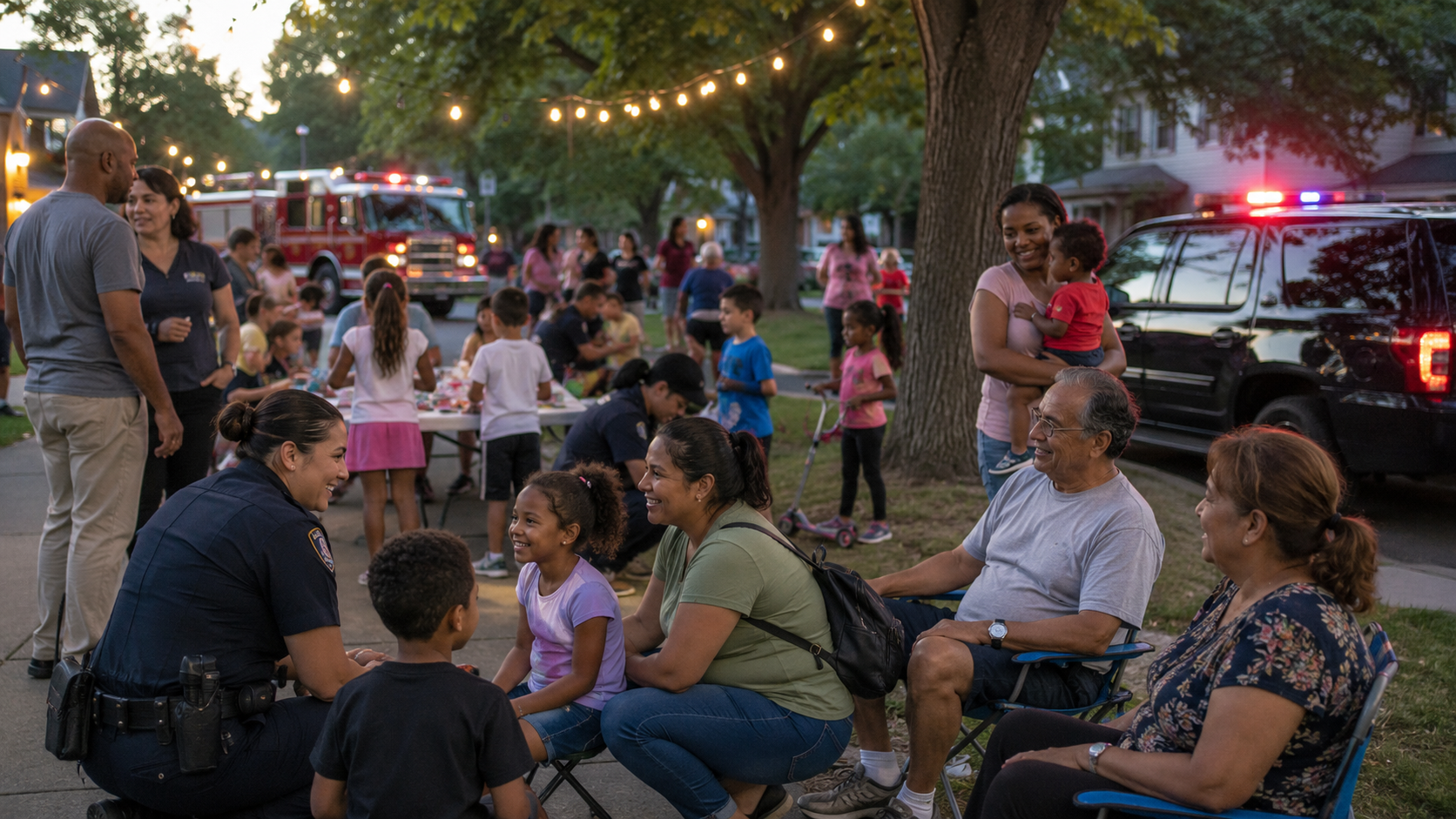
Reframing public safety, neighborhood trust, and civic connection as resilience infrastructure
On August 4, 2026, communities across the country will gather for National Night Out, an annual event often associated with block parties, police visits, public safety demonstrations, neighborhood watch groups, and family-friendly activities. At first glance, National Night Out may look like a single evening of community engagement. But its deeper value is much larger.
National Night Out should be understood as part of a community’s resilience infrastructure.
The National Association of Town Watch describes National Night Out as an annual community-building campaign that promotes police-community partnerships and neighborhood camaraderie. The campaign is designed to strengthen relationships between neighbors and law enforcement while restoring a sense of community. Cities across California are preparing for National Night Out 2026 on Tuesday, August 4, including Long Beach, San José, Cupertino, and San Francisco.
For the D’Andre D. Lampkin Foundation, the significance of National Night Out is not limited to public safety alone. It also connects to community resilience, civic trust, youth engagement, volunteerism, disaster preparedness, and the everyday relationships that help neighborhoods withstand stress.
When neighbors know one another, when public safety professionals are seen as partners, when families feel comfortable gathering in shared spaces, and when residents understand how to communicate before something goes wrong, a community becomes stronger.
National Night Out is one night. But the relationships it can help build should last all year.
Public Safety Begins Before a Crisis
Public safety is often discussed after harm has already occurred. Communities tend to focus on crime, emergencies, disorder, violence, traffic collisions, disaster response, or crisis intervention only after a problem becomes visible. National Night Out offers a different model. It invites communities to think about public safety before crisis, before fear, and before emergency response becomes necessary.
This matters because safety is not created by enforcement alone. It is built through trust, communication, visibility, shared responsibility, and prevention. A resident who knows the deputies, officers, firefighters, code enforcement staff, emergency managers, park staff, city workers, nonprofit leaders, and volunteers serving their neighborhood is more likely to ask questions, share concerns, report hazards, and participate in solutions.
The U.S. Department of Justice’s Community Relations Service describes its Strengthening Police and Community Partnerships program as a process that brings law enforcement and community leaders together to identify issues and develop collaborative solutions that improve police-community partnerships. That principle is central to National Night Out. The event creates a low-pressure environment where residents and public safety professionals can interact as people, not only through calls for service, enforcement actions, or emergency scenes.
When relationships are built only during conflict, the foundation is already weak. National Night Out gives communities a chance to build that foundation before it is tested.
Neighborhood Camaraderie Is a Safety Strategy
The phrase “neighborhood camaraderie” may sound simple, but it has real public safety value. A connected neighborhood is more likely to notice when something is wrong, check on vulnerable residents, support families during hardship, and communicate during emergencies.
In disaster preparedness, this is sometimes described as social connectedness or social capital. In public safety, it may be described as trust, cooperation, and community partnership. In community development, it may be described as belonging. Regardless of the language used, the concept is the same: communities are safer when people are not isolated from one another.
National Night Out encourages residents to step outside, meet neighbors, share contact information, speak with public safety personnel, learn about local resources, and build the basic relationships that become valuable during emergencies.
A neighbor who knows the elderly couple next door is more likely to check on them during a heat wave. A parent who knows other families on the block may be better able to coordinate childcare during a disruption. Residents who already know how to contact one another can share accurate information during a wildfire smoke event, power outage, evacuation, shelter-in-place order, or public safety incident.
That is why National Night Out should not be treated as a ceremonial event. It is a practical investment in the trust and social networks that make communities more resilient.
Community Policing and Community Resilience Are Connected
Community policing and community resilience are often discussed in separate professional circles. They should not be.
Community policing emphasizes relationships, problem-solving, visibility, partnership, and trust. Community resilience emphasizes preparedness, connection, adaptation, recovery, and shared responsibility. Both depend on the same underlying condition: people and institutions must be able to work together before, during, and after disruption.
The Department of Justice notes that the Office of Community Oriented Policing Services advances community policing nationally and provides resources to reduce crime and build trust between law enforcement and the communities they serve. Trust is not only a policing value. It is also an emergency management value, a nonprofit value, and a civic value.
During disasters, community members may need to follow evacuation instructions, shelter guidance, traffic control, health advisories, or public safety warnings. During everyday public safety challenges, residents may need to share information, report concerns, or work with agencies on prevention. In both cases, cooperation is easier when relationships already exist.
National Night Out creates a bridge between these worlds. It reminds communities that public safety is not simply the absence of crime. It is the presence of trust, communication, care, and coordination.
The Role of Nonprofits, Schools, Parks, and Faith Communities
National Night Out is usually described as a police-community event, but its strongest version is much broader. Public safety does not belong to law enforcement alone. It also includes the work of schools, parks, churches, nonprofits, neighborhood associations, youth organizations, local businesses, emergency managers, public health agencies, and residents themselves.
A school may provide a trusted gathering place. A park may serve as a family-friendly venue. A faith community may help reach seniors and families. A nonprofit may bring volunteers, food, outreach, or community education. A local business may sponsor supplies or activities. A public agency may offer preparedness information, traffic safety materials, or emergency resources.
This is the whole-community mindset applied to everyday safety. The same relationships that matter during National Night Out are the relationships that matter during heat waves, structure fires, floods, power outages, food insecurity, public health emergencies, and other community disruptions.
For the D’Andre D. Lampkin Foundation, this is where National Night Out connects directly to the Foundation’s broader mission. Building stronger, more resilient communities requires more than programs. It requires a culture of participation.
Residents need opportunities to engage before they are in crisis. Volunteers need places to serve. Youth need positive examples of leadership and service. Public agencies need trusted community partners. Nonprofits need relationships that allow them to support residents effectively.
National Night Out can help create that foundation.
Youth and Families Belong in the Public Safety Conversation
One of the most important strengths of National Night Out is that it often feels accessible to families. Children can meet public safety professionals in a positive setting. Parents can learn about local resources. Youth can see public service as something human and approachable rather than distant or intimidating.
This matters.
Young people form opinions about community, authority, safety, and civic responsibility long before adulthood. When they see neighbors gathering, volunteers serving, public safety personnel engaging respectfully, and community leaders working together, they receive a different message about what public life can look like.
National Night Out can also create opportunities to talk with youth about emergency preparedness, service, leadership, bullying prevention, safe recreation, responsible decision-making, and the importance of caring for one’s neighborhood.
A community that includes young people in public safety conversations is not only preparing them to avoid harm. It is preparing them to become future leaders.
From One Night to Year-Round Readiness
The greatest risk of National Night Out is that it becomes only a photo opportunity. The deeper opportunity is to use it as a starting point.
A strong National Night Out should lead to year-round action. Neighborhoods can use the event to create contact lists, identify vulnerable residents, recruit volunteers, start preparedness conversations, connect with local public safety agencies, invite residents into community service, and encourage neighbors to share stories of resilience and service.
Residents can ask simple questions:
Who on our block may need help during a heat wave?
Do we know how to contact one another during an emergency?
Where would we gather if power or communications failed?
Who has medical, mobility, language, transportation, or caregiving needs?
What local organizations can support us before and after crisis?
How can we make our neighborhood safer without waiting for something bad to happen?
These questions move National Night Out from celebration to preparation.
The D’Andre D. Lampkin Foundation’s Community Resilience Resources and Neighborhood Resilience Team tools are designed around this same idea: neighbors do not need to wait for disaster to begin organizing. A small group of residents can start with communication, preparedness, role assignment, and simple check-in systems.
National Night Out is a perfect moment to invite that kind of action.
Public Trust Must Be Maintained, Not Assumed
National Night Out also presents an opportunity for honesty. Public trust is not automatic. Communities have different experiences with law enforcement, public agencies, and local institutions. Some residents may feel safe approaching public safety personnel. Others may feel hesitant because of past experiences, family history, language barriers, immigration concerns, disability, race, income, or neighborhood conditions.
That reality should not be ignored. It should be respected.
Events like National Night Out are most meaningful when they create space for listening, not just presentation. Public safety agencies and civic leaders should not simply attend to be seen. They should attend to hear what residents are experiencing, what they are concerned about, what they need, and what would help them feel safer.
Scholarly work on police-community relationships continues to emphasize that trust and legitimacy are shaped by how people experience interactions, respect, fairness, and accountability. A 2026 study using Los Angeles Police Department body-worn camera footage examined how perceptions of respect in traffic stops vary across police-affiliated, justice-system-impacted, and non-affiliated Los Angeles residents, underscoring that public trust is shaped by community-specific experience and interpretation.
That lesson applies beyond traffic stops. Respect is not merely a matter of intent. It is experienced by the community.
National Night Out can help build trust, but only if the relationships formed that evening are carried forward with consistency, humility, and follow-through.
A Resilience Lens for National Night Out
Reframing National Night Out as community resilience infrastructure gives the event deeper meaning.
It is about crime prevention, but not only crime prevention.
It is about public safety, but not only law enforcement.
It is about neighbors, but not only social connection.
It is about preparedness, but not only emergency supplies.
It is about trust, but not only one evening of goodwill.
At its best, National Night Out strengthens the local relationships that communities rely on during everyday challenges and major disruptions. It helps residents know who is nearby, who serves their neighborhood, what resources exist, and how to participate.
That is why National Night Out belongs in the same conversation as emergency preparedness, community development, youth leadership, volunteerism, and whole-community resilience.
Conclusion: The Night Is Only the Beginning
National Night Out 2026 is an opportunity for communities to gather, connect, and strengthen relationships. But the real measure of success is not how many photos are taken, how many booths are set up, or how many people attend.
The real measure is what happens next.
Do neighbors stay connected?
Do residents feel more comfortable communicating with public safety agencies?
Do families learn about resources?
Do youth see positive examples of service?
Do volunteers step forward?
Do communities begin planning for emergencies before they happen?
Do public agencies and nonprofits build relationships that can be activated during crisis?
If the answer is yes, then National Night Out becomes more than an event.
It becomes a doorway into stronger community life.
The D’Andre D. Lampkin Foundation believes that resilient communities are built through service, trust, preparation, and shared responsibility. National Night Out reminds us that public safety begins with relationships — and that the work of building safer, stronger, more caring neighborhoods belongs to all of us.
References
National Association of Town Watch. “About National Night Out.” National Night Out.
Long Beach Police Department. “National Night Out — Tuesday August 4, 2026.” City of Long Beach.
San José Police Department. “National Night Out.” City of San José.
City of Cupertino. “National Night Out 2026.”
San Francisco Police Department. “National Night Out.”
U.S. Department of Justice, Community Relations Service. “Strengthening Police and Community Partnerships.”
U.S. Department of Justice. “Office of Community Oriented Policing Services.”
Golazizian, P., Rahmati, E., Trager, J., et al. “The Subjectivity of Respect in Police Traffic Stops: Modeling Community Perspectives in Body-Worn Camera Footage.” arXiv, 2026.

Leave a Reply
You must belogged in to post a comment.