


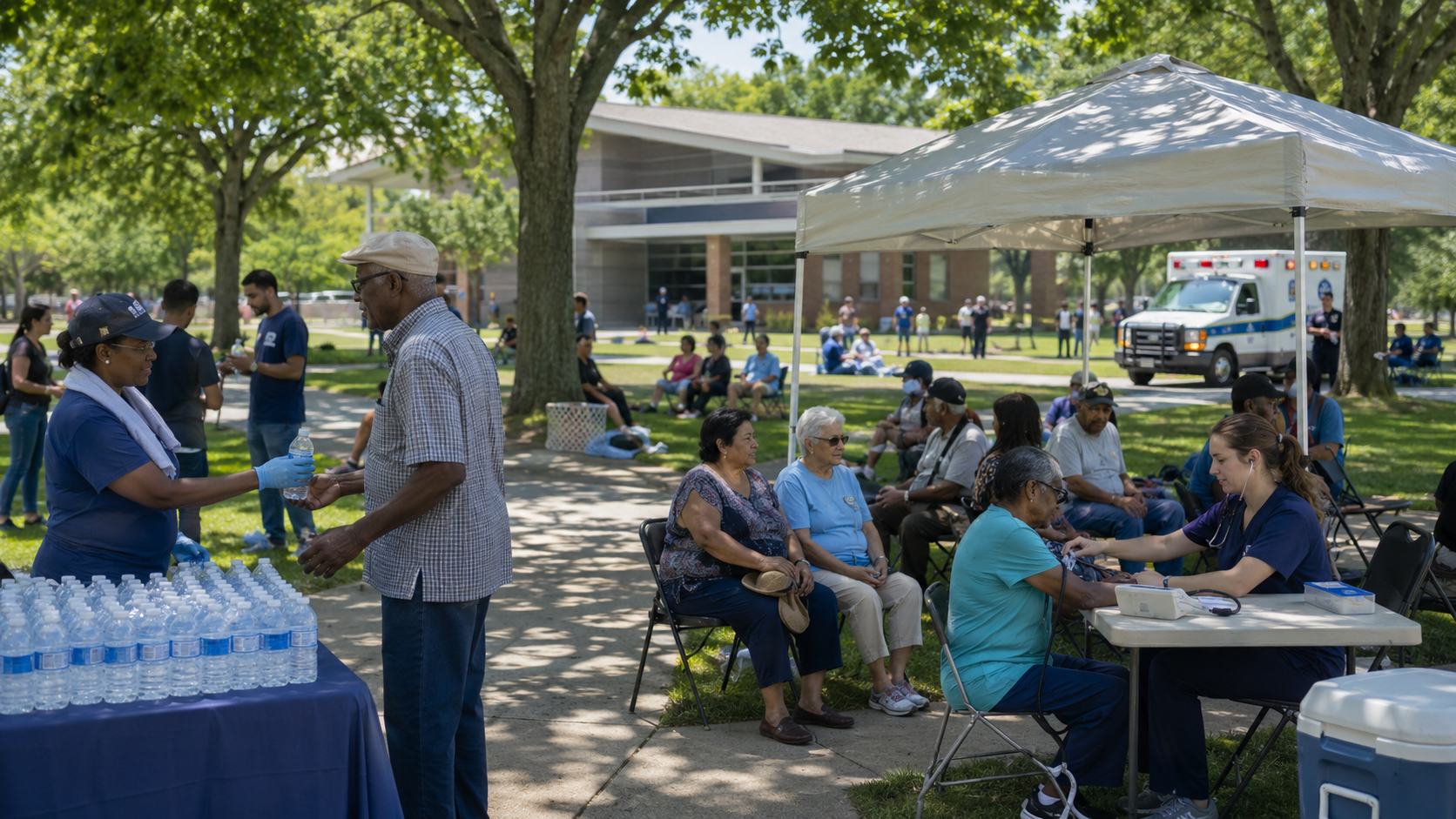
When communities think about disaster infrastructure, they often imagine fire stations, hospitals, emergency operations centers, bridges, power grids, evacuation routes, and communication systems. Those assets are essential. Yet one of the most overlooked forms of resilience infrastructure is often hiding in plain sight: the neighborhood park.
Parks are more than recreational amenities. In times of crisis, they can become gathering places, cooling spaces, commodity distribution points, public-information hubs, volunteer staging areas, wellness-check locations, and symbols of civic stability. This broader understanding aligns with contemporary resilience scholarship, which defines urban resilience as the capacity of urban systems to maintain, adapt, and transform in response to shocks and stresses across social, ecological, and technical networks (Meerow, Newell, & Stults, 2016). Parks sit at the intersection of those networks. They are ecological assets, social infrastructure, and public facilities capable of supporting emergency operations when communities are under stress.
Parks as Lifeline Connectors
The Federal Emergency Management Agency’s Community Lifelines framework provides a useful way to understand why parks matter during emergencies. FEMA developed Community Lifelines to help emergency managers communicate incident impacts in plain language and organize response around essential functions such as safety and security, food, hydration, health and medical care, energy, communications, transportation, hazardous materials, and water systems (FEMA, 2024).
Public parks can support several of these lifelines at once. A large regional park may serve as a public-safety staging area, temporary shelter-support location, commodity distribution point, cooling site, reunification area, or mobile medical location. A smaller neighborhood park may function as a trusted place where residents can receive information, bottled water, device-charging support, or referrals to community-based services. Parks do not replace hospitals, emergency operations centers, or formal shelter systems. Rather, they extend the reach of those systems into neighborhoods.
This distributed footprint matters because disasters are rarely experienced evenly. A citywide emergency may be managed from a centralized command structure, but harm is felt locally: in homes without air conditioning, on blocks without shade, at bus stops without seating, and among residents who cannot easily travel to distant service centers. Resilience infrastructure must therefore be close to people. Parks provide that proximity.
Public Space and Public Health
The public-health value of parks is well established. The World Health Organization has found that urban green spaces, including parks, playgrounds, and residential greenery, can promote mental and physical health, reduce morbidity and mortality, support physical activity, stimulate social cohesion, and reduce exposure to air pollution, noise, and excessive heat (World Health Organization, 2016).
The Centers for Disease Control and Prevention similarly emphasizes that physical activity improves health and quality of life, reduces the risk of chronic disease, and that active, walkable communities can support local economies, reduce air pollution, and help create more cohesive communities (CDC, 2024). During a crisis, these everyday health benefits become emergency-management advantages. A shaded park can reduce heat exposure. A familiar recreation center can reduce fear because residents already know where it is. A walking trail can support mental health after trauma. A sports field can become a temporary gathering point. A park that builds social connection before a crisis is better positioned to support public information, mutual aid, and recovery afterward.
Heat, Shade, and Climate Adaptation
Extreme heat demonstrates why parks must be treated as resilience infrastructure. Heat is often described as a silent disaster because it does not always produce the dramatic images associated with fires, floods, or earthquakes. Yet it can overwhelm hospitals, threaten outdoor workers, increase utility demand, and place seniors, unhoused residents, children, and medically vulnerable individuals at risk.
Green infrastructure can help reduce urban heat exposure. The U.S. Environmental Protection Agency explains that adding natural surfaces such as vegetation back into communities can mitigate the urban heat island effect and provide cooling (EPA, 2026). For this reason, park planning is also heat planning. Cities should not wait until a heat emergency to determine which parks have shade, restrooms, hydration access, backup power, transportation connections, lighting, and staffing capacity.
A park without shade, seating, accessible pathways, water, lighting, or safe transit access may appear green on a map, but it may be weak as resilience infrastructure. Conversely, a well-designed park with trees, shade structures, restrooms, water access, lighting, and nearby transit can become a practical public-health asset during heat events, power outages, smoke events, and other emergencies.
Social Cohesion as Emergency Capacity
Disasters test relationships before they test plans. A community with strong social ties is often better able to identify who needs help, share trusted information, organize volunteers, and recover after disruption. Research on urban green space and social cohesion has found that parks can support social connection when they are safe, well maintained, accessible, and designed with physical space and amenities that encourage people from different backgrounds to gather (Clarke et al., 2023).
This is one of the most important reasons parks matter. Public spaces create repeated opportunities for neighbors to encounter one another before a crisis. Parents meet at playgrounds. Seniors gather for walking groups. Youth participate in recreation programs. Volunteers clean up trails. Families attend community events. These interactions may seem ordinary, but they build the trust that becomes invaluable when formal systems are strained.
Scholars Viniece Jennings and Omoshalewa Bamkole have also argued that positive interactions in urban green spaces can catalyze social cohesion, social capital, and health-promoting behaviors (Jennings & Bamkole, 2019). In emergency-management terms, this means parks are not only physical places. They are relationship-building platforms. They help create the social infrastructure that allows communities to respond collectively when crisis occurs.
Parks as Recovery Infrastructure
Recovery is not limited to debris removal, rebuilding, and financial assistance. FEMA’s National Disaster Recovery Framework describes recovery as the process of restoring, redeveloping, and revitalizing a community’s health, social, economic, natural, and environmental systems (FEMA, 2025). Parks touch each of these systems.
Parks support health through recreation, walking, stress reduction, and outdoor activity. They support social recovery by giving people a place to gather, grieve, reconnect, and resume community life. They support economic recovery by hosting events, supporting local vendors, and attracting community activity back into affected areas. They support natural and environmental recovery through tree canopy, stormwater absorption, habitat protection, and heat mitigation.
This makes parks especially valuable after disasters. When homes, businesses, schools, or places of worship are damaged or inaccessible, public parks may be among the first spaces where people can safely gather again. They can host public briefings, assistance centers, volunteer coordination, food distribution, memorial events, and community meetings. In this way, parks help communities move from response to recovery.
Parks as Operational Platforms
Emergency managers should think of parks not only as places of refuge, but also as operational platforms. In a major incident, parks can support public-safety staging, commodity distribution, cooling operations, family reunification, temporary medical outreach, wellness checks, volunteer reception, donations management, behavioral-health support, and public-information functions.
For parks to perform these roles effectively, planning must be intentional. Agencies should assess access roads, lighting, restrooms, potable water, communications coverage, Americans with Disabilities Act accessibility, ingress and egress, traffic control, crowd flow, nearby transit, shaded areas, backup power options, and the ability to separate public-use areas from operational zones. A park’s emergency value is not determined only by acreage. It is determined by design, maintenance, staffing, public trust, and integration into emergency plans.
This is where parks departments, emergency managers, public-health officials, public works agencies, transportation planners, law enforcement, fire services, nonprofit organizations, and community-based groups must work together. Parks should be included in hazard mitigation plans, emergency operations plans, heat action plans, climate adaptation plans, and community recovery frameworks.
Equity and the Geography of Preparedness
Park access is also an equity issue. The Trust for Public Land’s ParkScore methodology evaluates major U.S. city park systems using measures across acreage, investment, amenities, access, and park-space equity (Trust for Public Land, 2026). This matters because unequal park access often mirrors broader patterns of inequality in health, transportation, housing, tree canopy, and public investment.
If a family cannot safely walk to a park on an ordinary day, that park is unlikely to serve as a trusted resource during crisis. If a park lacks lighting, restrooms, shade, programming, or basic maintenance, residents may not view it as safe or useful. If historically underserved neighborhoods have fewer high-quality parks, then resilience capacity is also unevenly distributed.
Equitable resilience planning should therefore prioritize parks in neighborhoods where heat risk, flood exposure, limited transportation, health disparities, poverty, disability, and low tree canopy overlap. Investment should not be based solely on where parks are already popular or politically visible. It should be based on where parks can reduce risk, improve health, and strengthen community capacity before the next crisis.
From Recreation Asset to Resilience Asset
Reframing parks as resilience infrastructure does not diminish their recreational purpose. It elevates it. Recreation is itself a form of prevention. A park that supports youth development, physical activity, cultural events, volunteerism, and intergenerational connection is already reducing risk before disaster strikes.
However, cities and counties should go further. Park master plans should be reviewed alongside emergency operations plans, hazard mitigation plans, climate action plans, public-health plans, and transportation plans. Parks departments should have seats at emergency-planning tables. Emergency managers should know which parks can support mass-care operations. Public works agencies should understand where green infrastructure can reduce flooding and heat. Public-health agencies should identify parks that can support outreach to seniors, children, unhoused residents, and medically vulnerable populations.
The question is not whether parks will be used during crisis. They already are. The question is whether they will be prepared, equipped, staffed, and integrated before the crisis begins.
Policy Recommendations
First, local governments should conduct a resilience audit of major parks and recreation facilities. This audit should examine shade, water, restrooms, lighting, backup power, communications, accessibility, traffic flow, transit access, emergency-vehicle access, and suitability for public-health or mass-care operations.
Second, cities should identify which parks can support FEMA Community Lifeline functions. A single park may not support every lifeline, but it may be well suited for food and hydration, public information, cooling, medical outreach, transportation support, or safety coordination (FEMA, 2024).
Third, park investments should be targeted where vulnerability is highest. Heat risk, flood exposure, limited vehicle access, disability, age, health disparities, income, and low tree canopy should guide where shade structures, trees, hydration stations, restrooms, lighting, and cooling features are prioritized.
Fourth, parks departments should be included in emergency exercises. Tabletop exercises and functional exercises should test how parks can be used for commodity distribution, reunification, cooling, crowd management, volunteer coordination, public-health outreach, and post-disaster public meetings.
Fifth, community-based organizations should be integrated into park-based resilience planning. The strongest emergency plans are not merely written by agencies. They are understood by residents, practiced with partners, and trusted before they are needed.
Conclusion
Parks are where the ordinary life of a community becomes visible. They are where children play, families gather, seniors walk, volunteers serve, and neighbors recognize one another. During crisis, those same spaces can become lifelines.
To treat parks merely as recreational amenities is to undervalue their role in public safety, public health, climate adaptation, social cohesion, and disaster recovery. The future of emergency management requires a broader understanding of infrastructure—one that includes not only concrete, steel, fiber optics, and power lines, but also shade trees, open fields, recreation centers, walking paths, playgrounds, and trusted public gathering places.
A resilient city is not only a city that can restore power, clear roads, and reopen buildings. It is a city where people know where to go, whom to trust, how to connect, and how to recover together. Parks make that possible. They are not separate from resilience. They are resilience infrastructure.
References
Centers for Disease Control and Prevention. (2024). Active People, Healthy Nation.
Clarke, M., et al. (2023). Factors that enhance or hinder social cohesion in urban greenspaces. Urban Forestry & Urban Greening.
Federal Emergency Management Agency. (2024). Community Lifelines.
Federal Emergency Management Agency. (2025). National Disaster Recovery Framework.
Jennings, V., & Bamkole, O. (2019). The Relationship between Social Cohesion and Urban Green Space: An Avenue for Health Promotion. International Journal of Environmental Research and Public Health.
Meerow, S., Newell, J. P., & Stults, M. (2016). Defining urban resilience: A review. Landscape and Urban Planning.
Trust for Public Land. (2026). ParkScore: About, Methodology, and FAQ.
U.S. Environmental Protection Agency. (2026). Reduce Heat Islands.
World Health Organization. (2016). Urban green spaces and health.

Leave a Reply
You must belogged in to post a comment.