


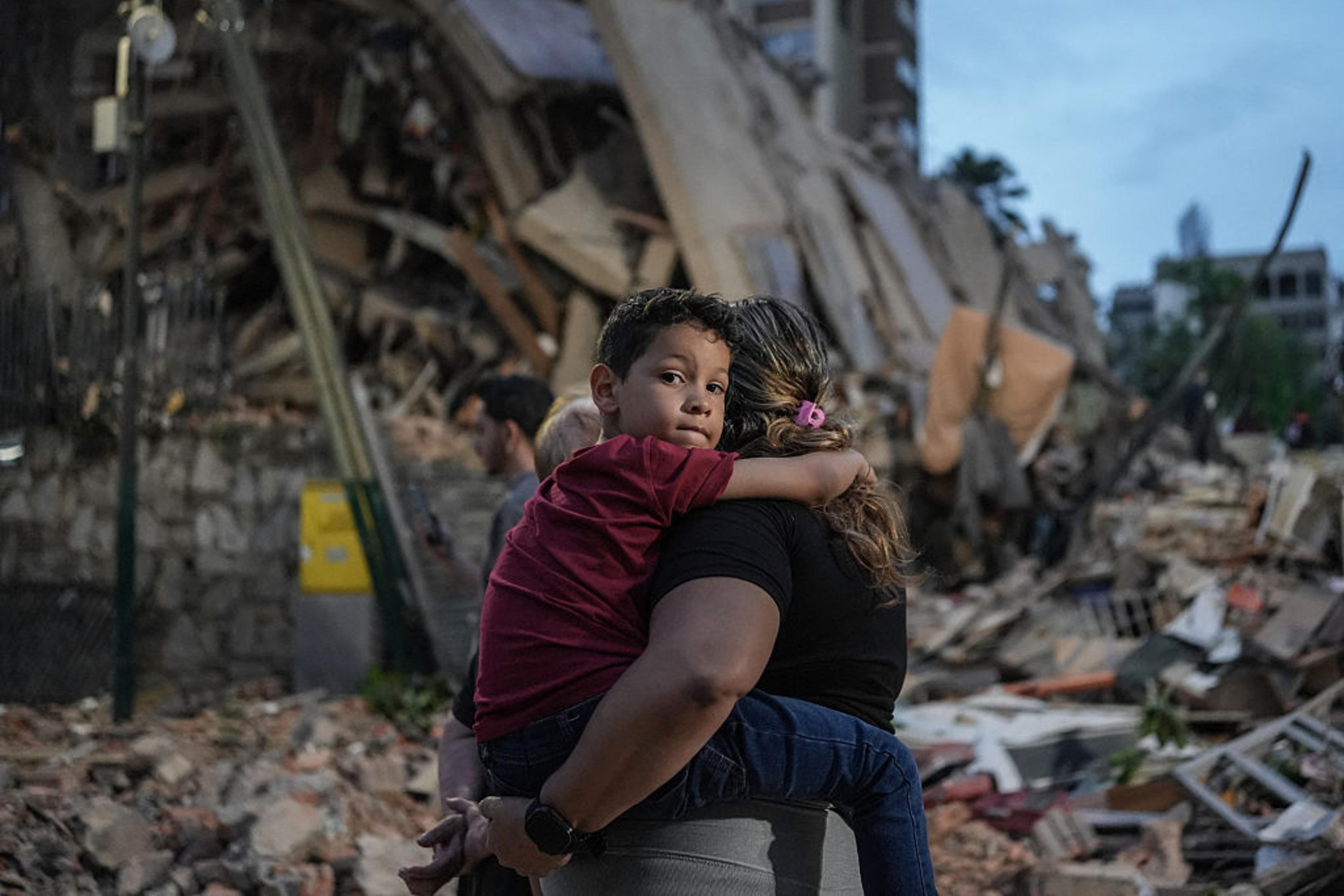
Manaure Quintero—AFP/Getty Images
How historical memory, modern response systems, and resilient recovery can help shape what comes next
Abstract
The 2026 Venezuela earthquake sequence is still unfolding as a humanitarian emergency. Search-and-rescue operations, emergency medical response, sheltering, public health stabilization, and infrastructure assessment remain urgent priorities. Yet every major disaster eventually forces a deeper civic question: will recovery simply replace what was lost, or will it create safer, stronger, and more resilient communities?
This article compares Venezuela’s 2026 earthquake response with the 1755 Lisbon earthquake, one of the most influential disasters in modern history. The comparison reveals how far national and international response capabilities have advanced, while also showing that the hardest work of recovery remains political, social, ethical, and institutional. As Venezuela transitions from response to recovery, its leaders and partners have an opportunity to look backward for guidance and forward with courage.
A Disaster Still in Motion
On June 24, 2026, Venezuela experienced a devastating seismic doublet: a magnitude 7.2 foreshock followed just 39 seconds later by a magnitude 7.5 mainshock near Yumare, Venezuela. The U.S. Geological Survey identified the magnitude 7.5 earthquake as a shallow strike-slip event near the boundary between the Caribbean and South American plates, and its PAGER assessment warned of a high likelihood of casualties and extensive economic losses.
The human toll remains fluid. In the first week after the earthquakes, reporting described widespread destruction across northern Venezuela, particularly in La Guaira and the Caracas metropolitan region. Associated Press reporting from La Guaira documented desperate searches through collapsed concrete, rising frustration over the pace of aid, and the arrival of international rescue teams as families searched for missing loved ones. Reuters later reported that catastrophe-modeling firm Verisk expected economic losses from the Venezuelan earthquake to exceed $10 billion, with severe damage in La Guaira and the Caracas region.
Venezuela is still in the response phase. That means the work remains focused on saving lives, stabilizing survivors, restoring critical infrastructure, supporting hospitals and shelters, clearing access routes, and managing the dangers of aftershocks, damaged buildings, heat, disease, trauma, and displacement.
But even while response operations continue, the recovery phase is approaching. When it arrives, Venezuela will face a question that has confronted every disaster-impacted society: what should be rebuilt, what should be changed, and what must never again be allowed to fail in the same way?
Lisbon, 1755: The Disaster That Changed Recovery
On November 1, 1755, Lisbon was struck by a catastrophic earthquake, followed by tsunami and fire. The disaster devastated the Portuguese capital and sent intellectual, political, religious, and scientific shockwaves across Europe.
Scholars have described the 1755 Lisbon earthquake as a milestone in the history of disaster governance because it helped shift public understanding away from superstition alone and toward organized state response, public order, urban planning, and empirical inquiry.
The response was led by Sebastião José de Carvalho e Melo, later known as the Marquis of Pombal. Within roughly 24 hours, an operational crisis structure began functioning through the monarchy, city authorities, the army, and religious institutions. Historical accounts summarize the immediate priorities in blunt terms: bury the dead, care for the living, and stabilize the city.
Lisbon’s recovery became more than reconstruction. It became a rethinking of the city. Military engineers debated whether to rebuild the city as it had existed, widen and correct the old street pattern, limit building heights, redraw the urban core entirely, or abandon the old city for a new site.
The resulting Pombaline reconstruction created a more ordered downtown, broader streets, improved urban form, and a new relationship between governance, commerce, public space, and safety.
The most enduring lesson is not that Lisbon created a perfect recovery model. It did not. Its recovery was shaped by monarchy, empire, hierarchy, coercive authority, and the political limits of its time. But Lisbon demonstrated something essential: after catastrophe, recovery is never only technical. It is moral, political, scientific, and civic.
1755 and 2026: A Comparison of Response Capabilities
The contrast between Lisbon in 1755 and Venezuela in 2026 is profound.
In 1755, national response capabilities depended on royal authority, military labor, religious networks, local workers, port access, printed notices, ships, messengers, and the command capacity of a centralized state. International assistance existed, but it moved slowly through diplomatic, imperial, religious, and commercial channels. Historical accounts note that European monarchies sent monetary aid, and construction materials and supplies arrived from countries including Spain, Britain, Germany, and the Netherlands.
There were no satellite maps, no international urban search-and-rescue standards, no airlifted technical rescue teams, no global humanitarian logistics system, no structural-collapse marking system, no digital emergency operations centers, and no modern medical evacuation network.
In 2026, Venezuela’s response reflects a very different era. International Urban Search and Rescue teams can mobilize with structural specialists, physicians, paramedics, canine search teams, communications capability, logistics support, and specialized tools for collapsed reinforced concrete.
The International Search and Rescue Advisory Group, known as INSARAG, now provides methodology for countries affected by sudden-onset disasters involving large-scale structural collapse and for international USAR teams responding into affected nations.
The United States response also illustrates the scale of modern capability. The U.S. Department of State announced deployment of a regional Disaster Assistance Response Team and urban search-and-rescue teams following the Venezuela earthquakes.
The Los Angeles County Fire Department’s international urban search-and-rescue team, USA-2, was activated by the Department of State and deployed with 71 members, six canine teams, and approximately 84,000 pounds of equipment. USA-2 joined Fairfax County’s USA-1 team to support search, rescue, and recovery assistance.
This is the modern advantage: specialized capacity can move quickly across borders. But modern capability does not erase vulnerability. Search-and-rescue teams can save lives after collapse, but they cannot retroactively enforce building codes. Military aircraft can move supplies, but they cannot instantly repair decades of underinvestment. International assistance can support a nation, but it cannot substitute for local preparedness, trusted public institutions, resilient infrastructure, and community-level readiness.
That is where the comparison between Lisbon and Venezuela becomes most useful. The most important difference between 1755 and 2026 is not simply equipment. It is the expectation that disaster should be governed, studied, coordinated, and learned from.
The Moment Between Response and Recovery
The response phase asks urgent questions: who is trapped, who is injured, where are shelters needed, which roads are passable, which hospitals are functioning, which buildings are unsafe, and where can aid be delivered?
The recovery phase asks more difficult questions: who was vulnerable before the earthquake, which neighborhoods suffered the most, which buildings should not be rebuilt as they were, what standards should govern reconstruction, how will public funds be protected, how will communities participate, and what kind of nation should emerge from the rubble?
The Sendai Framework for Disaster Risk Reduction emphasizes that preparedness must be strengthened for effective response and that recovery, rehabilitation, and reconstruction are critical opportunities to “Build Back Better” by integrating disaster risk reduction into development.
The United Nations Office for Disaster Risk Reduction defines “Build Back Better” as using recovery, rehabilitation, and reconstruction to increase resilience by integrating risk-reduction measures into infrastructure, social systems, livelihoods, economies, and the environment.
The World Bank’s Disaster Recovery Framework Guide similarly emphasizes that governments should ideally develop recovery frameworks before disasters occur. Such frameworks help establish a common vision, principles, roles, and preliminary recovery programs, allowing governments to prioritize disaster risk reduction and resilience in both short- and long-term development goals.
For Venezuela, that means recovery should not be treated only as a construction program. It should be a national resilience strategy.
What Venezuela Can Learn From Lisbon
Lisbon offers several lessons that remain relevant nearly three centuries later.
First, decisive leadership matters, but legitimacy matters too. Lisbon’s response was forceful and centralized. That helped impose order, but it also reflected the authoritarian politics of the 18th century. Venezuela’s recovery should learn from Lisbon’s decisiveness without repeating its exclusions. Communities must be participants in recovery, not passive recipients of decisions made elsewhere.
Second, data must guide recovery. After the 1755 earthquake, Pombal launched a remarkable inquiry through religious authorities to gather information about the earthquake’s timing, shaking, duration, intensity, geographic effects, tsunami behavior, and damage. The Lisbon Quake Museum describes this inquiry as an effort to understand natural causes, assess damage, and measure the magnitude of the disaster by collecting accurate data.
That lesson is urgent for Venezuela. Recovery should be grounded in transparent damage assessments, casualty and missing-person reporting, structural inspections, shelter data, infrastructure status, public health surveillance, and open communication with affected communities. Without reliable data, recovery becomes reactive, political, and unequal.
Third, rebuilding must reduce risk. Lisbon’s reconstruction considered street width, building height, safety, hygiene, and seismic risk. Venezuela now has an opportunity to examine vulnerable housing, informal settlements, hospitals, schools, ports, roads, utilities, and public buildings. Rebuilding should not merely return communities to their pre-earthquake condition if that condition exposed them to unacceptable risk.
Fourth, disaster memory must become public education. Lisbon’s earthquake became part of the city’s identity and, eventually, part of its public learning infrastructure. The Lisbon Quake Museum preserves the 1755 disaster through an immersive experience with ten rooms, a 1.5-hour journey into the history of the earthquake, and interpretation available in multiple languages. The museum also uses simulation and special effects to help visitors understand the earthquake in a safe educational setting.
This matters because communities often remember disaster emotionally but forget it operationally. The stories remain, but the plans fade. The anniversary arrives, but the preparedness investments stall. The memory becomes symbolic rather than practical.
Why Public Learning Institutions Matter
Every major disaster produces lessons. The tragedy is that many of those lessons are lost before they are organized, taught, and applied.
The Lisbon Quake Museum offers a model for how historical catastrophe can become civic education. It does not undo the suffering of 1755. It does not romanticize destruction. It preserves memory in a way that helps people understand risk, science, leadership, human behavior, and recovery.
The same principle should guide how communities learn from Venezuela’s 2026 earthquake sequence. Search-and-rescue teams will carry operational lessons. Engineers will identify structural lessons. Public health professionals will document medical and sanitation lessons. Local residents will understand neighborhood-level failures and strengths. Faith-based organizations, nonprofits, civic leaders, and volunteers will see where formal systems reached people and where community action filled gaps.
Those lessons should not remain scattered.
This is why the vision for a Center for Community Resilience is so important. A center dedicated to preparedness, recovery education, volunteer training, public exhibits, emergency management learning, and community-based resilience can help translate distant disasters into local readiness. The goal is not to exploit tragedy, but to honor it by learning from it.
Lisbon teaches us that memory can become preparedness. Venezuela will teach new lessons as well, and communities that are willing to study those lessons will be better prepared for the next earthquake, wildfire, flood, pandemic, or infrastructure failure.
Rebuilding a Nation, Not Just Structures
The Venezuela earthquake sequence is still a response-phase emergency. The first duty remains life safety. Survivors must be found, the injured treated, the displaced sheltered, and essential infrastructure stabilized.
But recovery is coming. When it does, Venezuela will face choices that cannot be answered by debris removal alone.
Will reconstruction strengthen building safety? Will recovery funds reach the most vulnerable? Will public data be transparent? Will schools and hospitals be rebuilt to withstand future hazards? Will displaced families be consulted? Will informal settlements be made safer or pushed further into vulnerability? Will international assistance help create local capacity, or only temporary relief? Will the country build back quickly, or wisely, or both?
Lisbon’s lesson is not that modern nations should copy an 18th-century recovery model. They should not. The lesson is that disaster can become a turning point when leaders combine urgency with vision, science with governance, and reconstruction with reform.
Venezuela now stands at that threshold.
The ground has already spoken. The world has responded. Soon, the deeper test will begin: whether the nation can transform loss into learning, rubble into resilience, and recovery into a safer future.

Leave a Reply
You must belogged in to post a comment.