


Disasters reveal an uncomfortable truth about public institutions: even the most capable government agencies cannot independently provide every resource, service, relationship, and specialized skill a community will need during a major emergency.
Fire departments suppress fires but may not be equipped to operate long-term shelters. Law enforcement agencies protect evacuation areas but may not know which residents lack transportation. Emergency management offices coordinate resources but may not own buses, warehouses, commercial kitchens, generators, telecommunications systems, or neighborhood gathering places. Public health agencies issue guidance but may struggle to reach residents who depend on trusted community leaders for information.
These gaps do not necessarily indicate government failure. They reflect the scale and complexity of modern disasters.
The United States’ national emergency doctrine recognizes this reality. The National Response Framework does not envision government acting alone. It describes a response system involving individuals, families, communities, nonprofit organizations, faith-based institutions, businesses, and every level of government. Its guiding principles include engaged partnership, tiered response, scalable and adaptable capabilities, unity of effort, and readiness to act (Federal Emergency Management Agency [FEMA], 2019).
Under this doctrine, nonprofits, congregations, residents, volunteers, and local businesses are not peripheral supporters standing outside the response system. They are potential capability providers within it.
Whole-community response is therefore not symbolic participation. It is operational capacity.
Emergency Management Is Larger Than Government
Government agencies are often the most visible participants during an emergency. Fire engines, patrol vehicles, ambulances, public works equipment, command posts, and emergency operations centers provide recognizable signs that an organized response is underway.
Much of the work that sustains affected residents, however, occurs beyond those visible operations.
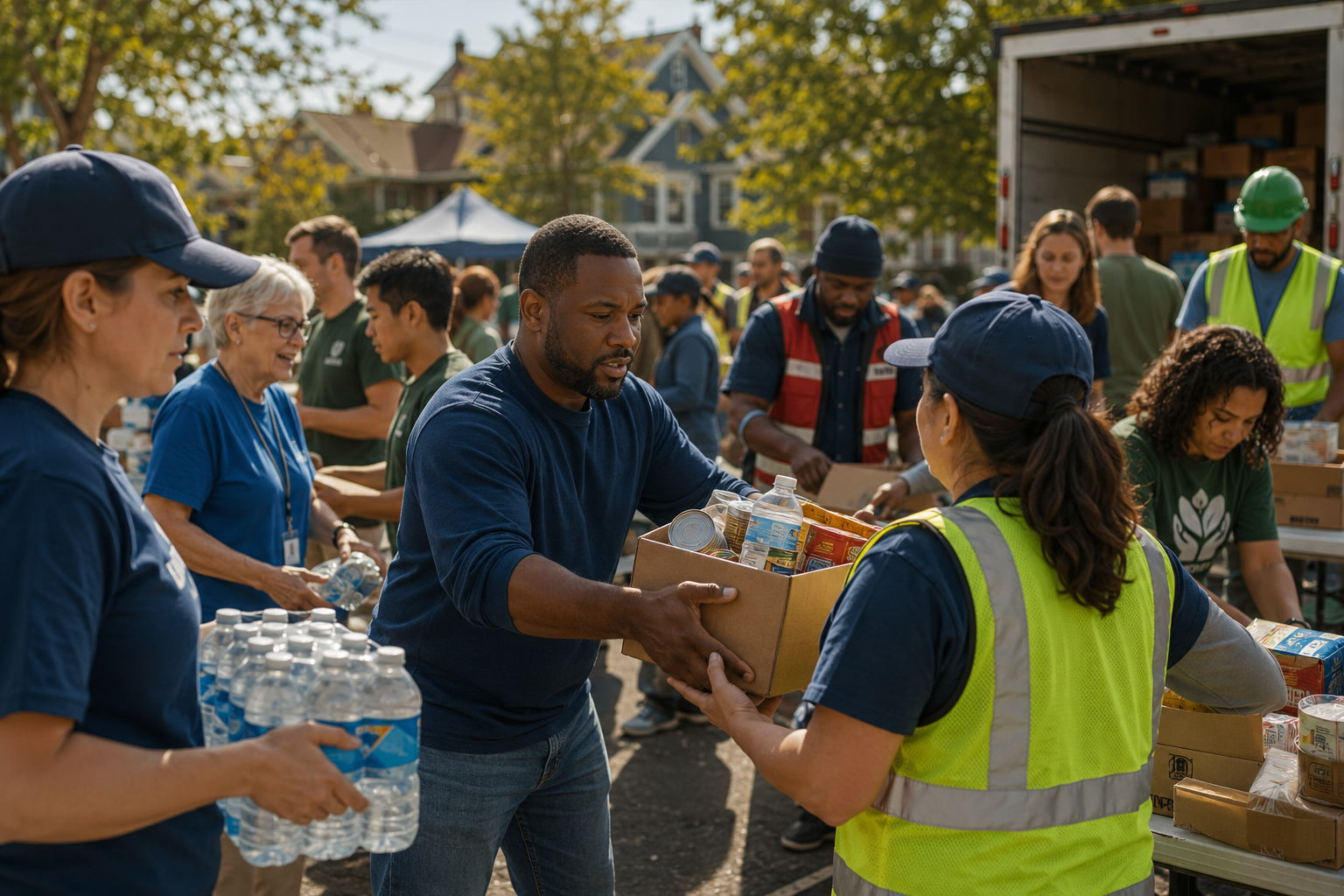
A church may prepare meals or provide temporary gathering space. A nonprofit organization may distribute water, hygiene supplies, clothing, or emergency financial assistance. A neighborhood association may identify residents who cannot evacuate without assistance. A local hotel may provide rooms for displaced families or responding personnel. A transportation company may provide buses or wheelchair-accessible vehicles. A grocery distributor may redirect food and refrigerated storage. Volunteers may conduct wellness checks, assist with debris removal, support donation centers, or help residents navigate disaster-assistance programs.
These activities are sometimes characterized as charity or goodwill. While they may be motivated by compassion, they also constitute measurable emergency capabilities.
FEMA’s whole-community approach recognizes that preparedness and resilience depend on understanding the needs of a community, identifying the resources already present within it, strengthening relationships, and empowering local participation. The doctrine specifically includes businesses, nonprofit organizations, faith-based institutions, schools, community groups, individuals, families, and governmental agencies (FEMA, 2011).
This approach changes the central planning question.
The traditional question is: What will government do for the community?
The whole-community question is: What capabilities exist throughout the community, and how will they be organized to accomplish shared objectives?
That distinction is essential because no emergency operations center can manufacture trusted relationships, neighborhood knowledge, private infrastructure, voluntary commitment, or culturally competent communication after a disaster has already begun.
Those capabilities must exist beforehand.
Tiered Response Begins at the Community Level
Tiered response is one of the National Response Framework’s principal doctrines. Incidents should generally be managed at the lowest jurisdictional level capable of addressing them. When an incident exceeds local capacity, additional resources may be requested from neighboring jurisdictions, state governments, interstate partners, and the federal government (FEMA, 2019).
This concept is often understood as a governmental ladder: municipal resources are supplemented by county resources, county resources by the state, and state resources by the federal government.
In practice, the first tier is even more local.
Individuals protect family members. Neighbors check on one another. Businesses initiate continuity plans. Community organizations distribute information. Faith leaders identify unmet needs. Nonprofits begin providing services. Volunteers organize personnel, equipment, and donations.
These actions frequently begin before a formal disaster declaration, before outside resources arrive, and sometimes before government agencies have developed a complete operating picture.
This does not mean community members should independently perform hazardous missions, enter restricted areas, or assume responsibilities for which they have not been trained. It means that local knowledge and community-based capabilities must be recognized and connected to the broader response system.
A neighborhood organization that knows which residents use electrically powered medical equipment possesses operationally significant information. A congregation with a commercial kitchen, accessible meeting space, passenger vans, multilingual volunteers, and trusted relationships possesses multiple response capabilities. A nonprofit organization accustomed to serving unhoused residents may be able to reach people who are unlikely to seek assistance at a conventional government facility.
Tiered response is strongest when these capabilities are documented, trained, and coordinated before an emergency rather than discovered by chance during one.
Mutual Aid Extends Beyond Public Agencies
Mutual aid is commonly associated with public safety resources moving between jurisdictions. Fire engines, law enforcement personnel, emergency medical teams, public works equipment, and incident management personnel are frequently deployed through established mutual-aid systems.
National Incident Management System guidance, however, defines mutual aid more broadly. Mutual-aid arrangements may involve personnel, equipment, facilities, supplies, teams, and services provided by government agencies, nongovernmental organizations, and private-sector entities (FEMA, 2024a).
This broader definition has important implications for both community development and emergency management.
Relationships with nonprofits, businesses, schools, congregations, and community organizations can be converted from informal expectations into dependable operational arrangements. A jurisdiction might establish agreements addressing:
- The use of a church, school, or community center as a reception, respite, reunification, distribution, or volunteer-processing site.
- Transportation assistance from a school district, nonprofit organization, paratransit operator, or private transportation company.
- Refrigerated storage, forklifts, generators, communications equipment, warehouse space, or heavy machinery supplied by local businesses.
- Feeding, sheltering, cleanup, rebuilding, case management, interpretation, spiritual care, or behavioral-health support provided by voluntary organizations.
- Procedures for requesting, authorizing, mobilizing, tracking, supporting, and demobilizing community-based resources.
Effective agreements should address personnel qualifications, resource descriptions, liability, reimbursement, insurance, credentialing, communications, supervision, documentation, and operational support (FEMA, 2024a).
The goal is not to bureaucratize compassion. It is to ensure that assistance can be safely requested, assigned, coordinated, sustained, and accounted for.
Without these arrangements, emergency officials may know that an organization is willing to help but remain uncertain about what it can provide, how quickly it can mobilize, whether its personnel are trained, who has authority to commit its resources, and how it will communicate during operations.
Good intentions become operational capacity only when they are connected to a dependable system.
Nonprofits as Capability Providers
Nonprofit organizations frequently operate where emergency response, human services, and long-term recovery intersect.
Their capabilities may include feeding, sheltering, donations management, volunteer coordination, cleanup, rebuilding, emergency financial assistance, legal services, disaster case management, behavioral-health support, disability services, language access, animal care, and assistance for households with unresolved needs.
These capabilities are especially important because disaster consequences are not distributed evenly.
Residents with limited transportation, unstable housing, disabilities, chronic health needs, limited English proficiency, low financial reserves, immigration concerns, or weak access to traditional institutions may encounter barriers that are not immediately visible through conventional damage assessments.
Nonprofits often possess service histories and community relationships that allow them to recognize these barriers early. They may know which apartment complex has a high concentration of older adults, which households recently lost employment, which residents are reluctant to interact with unfamiliar government representatives, or which neighborhood lacks reliable transportation.
National doctrine recognizes the need for coordination between voluntary organizations and government. FEMA’s Voluntary Agency Liaison function provides a formal connection among governmental agencies, voluntary organizations, faith-based groups, community organizations, and other partners supporting survivors. Voluntary Agency Liaisons help coordinate services, volunteers, donations, unmet-needs information, and relationships across the disaster cycle (FEMA, 2021).
This function demonstrates that nonprofit participation is not intended to operate on a separate charitable track. It can be integrated into mass-care coordination, resource management, situation reporting, donations management, public information, survivor services, and long-term recovery.
The strongest nonprofit organizations are not merely present after disaster. They understand emergency management structures, maintain continuity plans, identify their capabilities and limitations, participate in exercises, and know how to communicate with incident command or an emergency operations center.
Faith-Based Organizations as Trusted Infrastructure
Faith-based organizations occupy a distinctive place within whole-community doctrine.
Their value extends beyond spiritual care, although emotional and spiritual support may be essential after trauma. Congregations may possess buildings, commercial kitchens, parking areas, passenger vehicles, communication networks, volunteers, multilingual leaders, child-care capacity, and longstanding relationships with residents.
They may also reach populations that governmental alerts, news coverage, and conventional outreach do not consistently reach.
Trust is itself an emergency capability.
During a crisis, people are more likely to act when information comes through a source they recognize and believe. A faith leader who can explain an evacuation order, correct misinformation, identify a religious or cultural concern, or encourage residents to use an emergency service may improve public compliance and reduce harm.
FEMA’s guidance for engaging faith-based and community organizations encourages emergency managers to assess community needs, engage organizations, plan together, learn from partners, exercise capabilities, and sustain relationships. The guidance emphasizes that engagement should occur throughout the emergency-management cycle rather than beginning only after disaster strikes (FEMA, 2025a).
Trust, however, must be paired with coordination.
An organization that independently opens a shelter, solicits donations, or deploys volunteers without coordinating with incident authorities may unintentionally duplicate services, create safety concerns, overwhelm transportation routes, or divert resources from identified priorities.
The solution is not to discourage community action. It is to ensure that trusted organizations understand how to enter the response system, communicate their capabilities, receive verified information, report unmet needs, and align their work with incident objectives.
A congregation should not be designated as a shelter merely because it owns a large building. Shelter operations may require accessibility, backup power, sanitation, security, trained personnel, food-safety procedures, communications, registration systems, medical support, and the ability to accommodate people with access and functional needs.
A facility becomes a capability only when the organization can reliably activate and sustain it.
Residents and Volunteers as Local Surge Capacity
Residents are often portrayed primarily as recipients of emergency services. Whole-community doctrine recognizes them as active participants in preparedness and response.
Prepared households reduce immediate pressure on emergency services. Neighbors may conduct informal welfare checks, share supplies, assist with evacuation, provide local information, and identify conditions that official assessments have not yet captured.
Organized volunteer programs can expand this capacity by providing training, supervision, communications procedures, and clearly defined roles.
The Community Emergency Response Team program, for example, educates volunteers about locally relevant hazards and basic disaster-response skills. CERT members may support their communities while operating within defined organizational and safety structures (FEMA, 2026a).
Volunteers nevertheless require management.
Major disasters often produce spontaneous volunteers whose willingness to help exceeds the affected jurisdiction’s immediate ability to register, assign, equip, supervise, or protect them. Uncoordinated volunteers may arrive at unsafe locations, interfere with professional operations, create accountability problems, or become disaster victims themselves.
Effective plans should establish procedures for volunteer registration, credential verification, safety briefings, assignment, supervision, communications, documentation, feeding, transportation, and demobilization. They should also distinguish between affiliated volunteers operating through established organizations and spontaneous volunteers who have not yet been connected to a recognized group.
Readiness to act does not mean acting without direction. It means that residents and volunteers understand whom to contact, where to report, what they are qualified to do, and how their work supports established priorities.
Community initiative should be encouraged, but it must be converted into safe and useful mission support.
Local Businesses and Community Lifelines
The private sector is indispensable to disaster operations because many of the services required to stabilize a community are privately owned or operated.
FEMA’s community-lifelines construct organizes incident information and stabilization efforts around fundamental services involving safety and security; food, hydration, and shelter; health and medical services; energy; communications; transportation; and hazardous materials (FEMA, 2023).
Each lifeline depends on businesses, infrastructure operators, suppliers, contractors, and employees.
A jurisdiction cannot stabilize energy systems without utilities and fuel providers. It cannot sustain food and shelter operations without distributors, grocers, commercial kitchens, lodging providers, sanitation companies, and transportation networks. Communications depend on telecommunications companies, internet providers, equipment suppliers, and repair contractors. Health and medical operations depend on hospitals, pharmacies, clinics, laboratories, medical suppliers, and home-health providers.
Businesses also provide situational awareness.
Retailers may observe shortages before government agencies receive formal reports. Delivery companies may know which roads remain passable. Employers may identify workforce disruptions, housing displacement, or transportation problems. Small businesses may reveal neighborhood-level economic effects that are obscured by regional data.
FEMA encourages jurisdictions to build private-public partnerships that support information sharing, continuity, infrastructure restoration, supply-chain coordination, emergency planning, and community resilience (FEMA, 2025b).
Businesses should therefore be viewed as more than vendors or disaster victims. They are infrastructure operators, employers, resource providers, information sources, and recovery anchors.
Their continuity is also a public concern. When local businesses cannot reopen, residents may lose wages, food access, health services, child care, transportation, or other essential services. Business continuity and community recovery are closely connected.
Unity of Effort Does Not Require a Single Organization
Whole-community response does not require every participant to become part of government or surrender its independence.
Nonprofits retain their missions, governing boards, donors, professional standards, and deployment procedures. Faith-based organizations maintain their religious identities and responsibilities. Businesses remain accountable to employees, customers, regulators, and owners. Neighborhood associations may operate without formal command structures.
National doctrine instead emphasizes unity of effort. Participants coordinate their activities toward shared objectives while retaining their own authorities and organizational identities (FEMA, 2019).
Unity of effort is achieved when organizations share enough information to avoid conflict, understand incident priorities, identify unmet needs, and align available capabilities with the broader response strategy.
National Voluntary Organizations Active in Disaster advances a similar model through its four guiding principles: communication, coordination, collaboration, and cooperation. These principles allow independent organizations to work together without requiring one voluntary organization to command all the others (National VOAD, n.d.).
In practical terms, unity of effort may involve:
- Nonprofit representatives participating in emergency operations center coordination calls.
- Voluntary Agency Liaisons communicating survivor needs and available services.
- Businesses sharing infrastructure, supply-chain, or lifeline information.
- Faith-based organizations distributing verified public information through trusted networks.
- Community groups identifying residents who require transportation, language assistance, or wellness checks.
- Voluntary organizations coordinating donations, cleanup, sheltering, feeding, and long-term recovery assistance.
The objective is not organizational uniformity. It is coordinated action.
Community Development Is Emergency Preparedness
Whole-community doctrine also establishes a direct connection between emergency management and community development.
A community with strong nonprofit institutions, trusted neighborhood leaders, accessible public spaces, stable local businesses, reliable transportation, social networks, and effective communication systems possesses greater disaster-response capacity.
Conversely, a community experiencing chronic disinvestment, social isolation, limited transportation, weak institutional relationships, inaccessible facilities, or economic instability enters a disaster with fewer resources and narrower margins for failure.
Investments made before disaster can therefore serve both community-development and emergency-management objectives.
Supporting local nonprofits expands service capacity. Strengthening neighborhood organizations improves information flow. Preserving accessible community spaces creates potential locations for emergency services. Supporting small businesses helps maintain employment and essential goods. Building relationships across cultural and religious communities improves trust. Expanding transportation access improves both daily mobility and evacuation capacity.
Resilience is not created solely through emergency plans, equipment purchases, or specialized response teams. It is also created through the everyday work of building communities in which residents and institutions have the relationships and resources needed to solve problems together.
Community development is not separate from emergency preparedness. It creates many of the conditions upon which effective emergency response depends.
Converting Participation into Operational Capacity
A whole-community plan should do more than list stakeholder names and contact information. It should explain how community capabilities will be activated, coordinated, supported, and sustained.
The first step is capability identification. Jurisdictions should work with partners to document available facilities, personnel, equipment, vehicles, generators, kitchens, warehouses, communications systems, language skills, technical expertise, and service relationships.
The second step is integration. Appropriate capabilities should be connected to emergency operations plans, continuity plans, resource-management procedures, mutual-aid arrangements, and public-information strategies.
The third step is training. Community partners should understand the basic structures through which incidents are managed, including resource requests, emergency operations center coordination, incident command, public information, volunteer management, documentation, and safety.
The fourth step is exercising. Nonprofits, businesses, congregations, schools, and volunteer organizations should do more than observe exercises. They should practice receiving assignments, reporting conditions, requesting resources, sharing information, activating facilities, documenting services, and coordinating with government agencies.
The fifth step is sustainment. Contact lists, agreements, capabilities, and leadership arrangements must be reviewed regularly. An organization that possessed buses, warehouse space, or trained volunteers several years ago may no longer have them. A facility may have been renovated, sold, damaged, or placed under new management.
Finally, community organizations must plan for their own continuity. A nonprofit cannot support survivors if its employees cannot communicate or its facility is inaccessible. A business cannot provide emergency transportation without drivers, fuel, maintenance, and dispatch capabilities. A congregation cannot operate a distribution center without personnel, security, sanitation, traffic control, and supply procedures.
Operational capacity must be realistic, supportable, and repeatable.
Whole Community as a Readiness Standard
Whole-community response is sometimes reduced to inclusive language: invite more people to meetings, acknowledge additional stakeholders, or add community organizations to a planning document.
Inclusion matters, but doctrine demands more.
A partner included on a contact list but excluded from training and exercises is not fully integrated. A building identified as a shelter without staffing, accessibility, security, sanitation, and logistics plans is not a shelter capability. Volunteers without assignments, supervision, communications, or safety procedures are not dependable surge capacity. A business relationship that begins only after a supply chain has failed is not preparedness.
Whole-community response becomes operational when relationships are translated into plans, agreements, trained personnel, communications pathways, resource inventories, and practiced procedures.
Government remains responsible for exercising public authority, coordinating emergency operations, and protecting life and property. But public agencies cannot independently own every resource, operate every facility, understand every neighborhood, or maintain every trusted relationship a community will need.
Those capabilities are distributed across the community.
The central lesson of whole-community doctrine is therefore not merely that everyone has a role. It is that communities must deliberately identify, organize, and sustain the capabilities already present among their people and institutions.
Whole-community response is not symbolic participation. It is the operational capacity of a community prepared to act together.
References
Federal Emergency Management Agency. (2011). A whole community approach to emergency management: Principles, themes, and pathways for action. U.S. Department of Homeland Security.
Federal Emergency Management Agency. (2019). National Response Framework (4th ed.). U.S. Department of Homeland Security.
Federal Emergency Management Agency. (2021). IS-289: Voluntary Agency Liaison overview. Emergency Management Institute.
Federal Emergency Management Agency. (2023). Community Lifelines Implementation Toolkit (Version 2.1). U.S. Department of Homeland Security.
Federal Emergency Management Agency. (2024a). National Incident Management System guideline for mutual aid. U.S. Department of Homeland Security.
Federal Emergency Management Agency. (2025a). Engaging faith-based and community organizations: Planning considerations for emergency managers. U.S. Department of Homeland Security.
Federal Emergency Management Agency. (2025b). Building private-public partnerships. U.S. Department of Homeland Security.
Federal Emergency Management Agency. (2026a). Community Emergency Response Team. U.S. Department of Homeland Security.
National Voluntary Organizations Active in Disaster. (n.d.). About National VOAD and the four Cs.

Leave a Reply
You must belogged in to post a comment.