


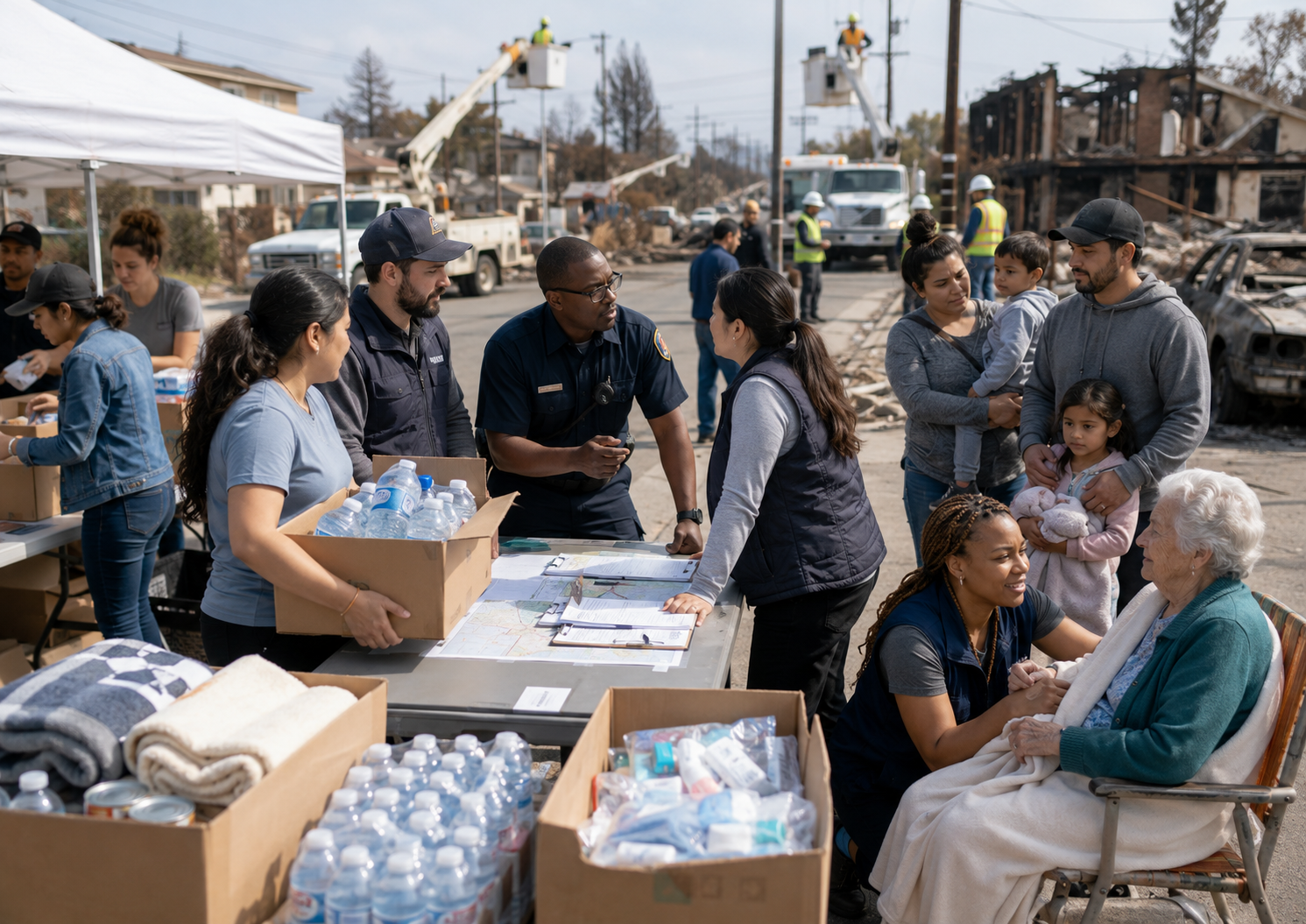
Nonprofits in disaster response serve as force multipliers by extending public-sector capacity, connecting emergency agencies with trusted community networks, and supporting survivors throughout long-term recovery. Disaster response is most visible through the work of firefighters, law enforcement officers, emergency medical personnel, public health officials, emergency managers, and government agencies. These professionals carry legal authorities and operational responsibilities that cannot be transferred to charitable organizations. Yet nearly every major disaster also reveals another essential layer of the response system: nonprofit, faith-based, philanthropic, and community-based organizations.
These organizations operate food banks, shelters, youth programs, health clinics, houses of worship, disability services, neighborhood associations, legal-aid programs, transportation services, and volunteer networks long before an emergency occurs. When disaster disrupts ordinary systems, their existing relationships, facilities, knowledge, and personnel can be redirected toward urgent community needs.
Nonprofits should therefore not be viewed merely as charitable organizations that appear after government resources have been exhausted. When adequately prepared, funded, and integrated into emergency plans, they can serve as force multipliers—expanding the reach, speed, cultural competence, and endurance of the larger disaster-response system.
The National Response Framework describes emergency response as a whole-community undertaking, while the National Incident Management System provides a common structure through which government agencies, nongovernmental organizations, and private-sector partners can work together. These national doctrines recognize a practical reality: no single agency or level of government possesses every relationship, resource, skill, or capability required during a major disaster (Federal Emergency Management Agency [FEMA], 2017, 2019).
What It Means to Be a Force Multiplier
A force multiplier is a capability that enables existing personnel and resources to accomplish more than they could independently. For nonprofits, this does not mean replacing first responders or assuming governmental authority. It means increasing the effectiveness of the overall response by contributing assets that public agencies may not possess in sufficient quantity or may not be positioned to deliver directly.
Those assets may include:
- Trusted relationships with residents
- Multilingual and culturally competent communication
- Trained volunteers
- Donated goods and philanthropic funding
- Food preparation and distribution systems
- Community facilities and transportation resources
- Spiritual care and behavioral health support
- Disability advocacy and accessibility expertise
- Disaster case management
- Neighborhood-level knowledge
- Connections with populations that formal systems may struggle to reach
Research examining nongovernmental entities involved in disasters found that nonprofit organizations, religious institutions, and businesses frequently contributed flexibility, rapid service delivery, and access to socially or economically marginalized populations. The research also identified important limitations, including uneven nonprofit capacity, fragmented coordination, and substantial differences in the resources available from one community to another (Sledge & Thomas, 2019).
Being a force multiplier therefore requires more than compassion or a willingness to help. It requires preparation, clearly defined roles, sustainable funding, operational discipline, and relationships established before the emergency begins.
Trusted Relationships Extend the Reach of Emergency Communication
One of the most important resources a nonprofit can contribute during a disaster is trust.
Emergency officials may issue accurate warnings, evacuation instructions, public health guidance, shelter information, and recovery updates. The effectiveness of those messages, however, depends on whether people receive, understand, believe, and act upon them.
Language barriers, disabilities, limited internet access, social isolation, misinformation, immigration concerns, and previous negative experiences with institutions can prevent official messages from reaching everyone equally. A technically accurate warning is of limited value when the person at risk cannot access it, does not understand it, or does not trust its source.
Community organizations often maintain relationships with residents whom traditional emergency-alert systems do not consistently reach. Faith leaders, neighborhood associations, youth organizations, disability advocates, food-distribution programs, cultural organizations, and community health workers may already know which residents require translated information, transportation, medication support, wellness checks, or direct personal outreach.
The Centers for Disease Control and Prevention identifies faith- and community-based organizations as trusted messengers that can help emergency officials develop, test, translate, and distribute information. Effective communication networks should allow information to move in both directions: officials send verified instructions to the public, while community partners report rumors, unmet needs, access barriers, and changing conditions back to emergency managers (Centers for Disease Control and Prevention [CDC], 2023).
Research involving African American churches during the COVID-19 emergency similarly demonstrated how established community partnerships could distribute culturally relevant information and connect residents with food, testing, utility assistance, and other resources. The credibility of the messages was strengthened because they came through people and institutions the community already knew (Brewer et al., 2020).
Trust cannot be improvised during an evacuation. It is built through years of consistent service, communication, and presence.
Existing Community Infrastructure Creates Speed and Flexibility
Nonprofits often possess physical and organizational infrastructure that can be adapted during emergencies.
A church fellowship hall may become a distribution center. A youth facility may support family reunification or child care. A food pantry may expand into emergency feeding. A transportation organization may assist older adults and people with disabilities. A community foundation may establish a disaster-relief fund. A legal-services organization may help survivors replace documents, understand housing protections, appeal benefit decisions, or avoid post-disaster fraud.
Because many nonprofits are smaller and less bureaucratic than large public institutions, they may be able to modify programs, redirect personnel, or make limited emergency expenditures quickly. Their familiarity with local conditions can also help them recognize emerging needs before those needs appear in formal assessments or government data.
Research conducted in Victoria, Australia, found that nonprofit contributions extended across preparedness, response, and recovery. Activities included fire-risk education, food-bank coordination, vaccination support, community gatherings, volunteer mobilization, and access to locally available equipment and facilities. The researchers concluded that nonprofit organizations can strengthen a community’s ability to respond before, during, and after a disaster (Roberts, Archer, & Spencer, 2021).
This flexibility is especially valuable during the first hours and days of an emergency, when public agencies must prioritize life safety, incident stabilization, infrastructure protection, and the restoration of essential services.
Volunteers Provide Surge Capacity—When Properly Coordinated
Disasters inspire people to help. Volunteers may prepare meals, distribute supplies, clear debris, conduct wellness checks, staff call centers, translate information, assist at shelters, care for animals, or help survivors complete assistance applications.
This civic response can substantially expand a community’s human-resource capacity. Research on informal volunteerism has found that ordinary residents are frequently among the first people to provide assistance and often remain involved after formal emergency operations have ended (Whittaker, McLennan, & Handmer, 2015).
Goodwill alone, however, does not guarantee an effective or safe operation.
Self-deployment, inadequate training, unclear supervision, poor accountability, liability concerns, and a lack of personal protective equipment can place volunteers and survivors at risk. Uncoordinated volunteers may enter hazardous areas, duplicate existing services, congest access routes, distribute inappropriate donations, or create additional demands for first responders.
Nonprofits can serve as the bridge between the public’s desire to help and the operational discipline required during a disaster. Volunteer reception centers, credentialing procedures, safety briefings, check-in systems, assignment tracking, liability coverage, and supervisory structures transform spontaneous assistance into organized capability.
National Voluntary Organizations Active in Disaster distinguishes between affiliated volunteers connected to established organizations and spontaneous volunteers who arrive without being incorporated into an existing structure. Its guidance encourages communities to match volunteer skills with verified needs through experienced organizations and Long-Term Recovery Groups (National VOAD, 2023).
The lesson is not to discourage spontaneous volunteerism. It is to plan for it.
Specialized Services Close Critical Gaps
Government disaster programs are necessarily designed around legal authorities, standardized eligibility requirements, and defined categories of assistance. Survivors’ lives, however, do not always fit neatly within those categories.
A family may qualify for temporary shelter but still need transportation, child care, work clothing, replacement identification, pet boarding, or immigration assistance. An older adult may need medication refrigeration during an extended power outage. A person with limited English proficiency may require an advocate who can explain recovery programs. A survivor with a disability may need durable medical equipment or accessibility modifications. An unhoused resident may have no conventional documentation of disaster-related loss.
Nonprofits can respond to these circumstances through specialized missions and flexible charitable resources.
Disability organizations can advise shelter operators on accessibility and effective communication. Behavioral health providers can deliver trauma-informed services. Cultural organizations can help ensure that assistance is appropriate for the population being served. Legal-aid organizations can help survivors address housing, employment, insurance, and consumer-protection concerns. Animal-welfare organizations can support evacuation and sheltering for pets and livestock.
These services are not peripheral to disaster response. They influence whether residents can evacuate safely, remain in shelters, maintain medical care, understand official instructions, return to employment, and pursue a stable recovery.
Community Organizations Improve Situational Awareness
Nonprofits do more than carry information from government to the public. They can also help government understand what is happening within the community.
Traditional damage assessments may document destroyed structures, utility outages, road closures, and infrastructure failures. Those assessments do not always capture less visible consequences such as food insecurity, displacement, medication loss, interrupted child care, wage loss, transportation barriers, social isolation, or fear within immigrant communities.
Community organizations are often among the first to recognize these conditions because residents contact them for assistance. Food banks see sudden increases in demand. Schools and youth organizations learn which families have been displaced. Faith leaders hear about older residents living alone. Disability advocates identify inaccessible shelters or communication systems. Housing organizations encounter tenants facing illegal eviction or price gouging.
When these observations are incorporated into emergency coordination, nonprofit organizations become sources of community-level intelligence. They help incident leaders understand not only what has been damaged, but how the disaster is affecting people.
This two-way information exchange should be formalized through emergency operations center liaisons, voluntary agency coordination groups, human-services branches, community advisory networks, and scheduled situational briefings. Nonprofit participation should not depend solely on informal relationships or personal access to government officials.
Nonprofits Sustain Recovery After Public Attention Declines
The most visible phase of a disaster may last several hours or days. Recovery can continue for years.
Survivors may face insurance disputes, debris removal, temporary housing, employment interruption, school displacement, health complications, documentation requirements, rebuilding costs, and repeated applications for assistance. Some households discover unmet needs only after emergency shelters close and immediate relief organizations begin to leave.
Long-Term Recovery Groups bring nonprofit organizations, faith communities, government representatives, businesses, philanthropic institutions, and other partners together to coordinate disaster case management, donated resources, volunteer labor, home repairs, and assistance for unmet needs.
Research examining these groups found that they frequently address gaps left after government assistance, insurance, personal savings, and other resources have been exhausted. Those needs may include housing repairs, medical expenses, utility costs, child care, transportation, education, and employment-related assistance (Meyer et al., 2023).
National VOAD describes long-term recovery as the period in which affected communities pursue permanent recovery solutions and establish structures for coordinating assistance. Effective Long-Term Recovery Groups do not merely distribute charity. They organize information, manage cases, identify duplication, preserve donor intent, and help survivors develop realistic recovery plans (National VOAD, 2023).
This sustained presence is one of the nonprofit sector’s greatest strengths. Community organizations often remain after temporary field offices close, national media attention moves elsewhere, and emergency donations begin to decline.
The 2025 Los Angeles Fires: A Whole-Community Recovery Challenge
The January 2025 Los Angeles County wildfires demonstrate why catastrophic disasters require layered public, private, philanthropic, and nonprofit capabilities.
The Palisades and Eaton Fires burned more than 38,000 acres and destroyed more than 16,000 structures. The destruction affected housing, employment, schools, places of worship, small businesses, nonprofit organizations, transportation systems, and neighborhood networks across multiple communities.
No single organization could independently address needs of that magnitude.
Fire agencies carried out suppression and rescue operations. Law enforcement agencies supported evacuations, security, traffic management, and access control. Emergency management organizations coordinated resources and intergovernmental assistance. Public agencies administered debris removal, public benefits, permitting, infrastructure restoration, and recovery programs.
At the same time, nonprofit and philanthropic organizations mobilized direct financial assistance, food, temporary lodging, donated goods, mental health services, legal assistance, volunteer labor, and culturally competent outreach. Los Angeles County and the City of Los Angeles also established public-private relief initiatives supporting affected households, workers, small businesses, and nonprofit organizations. Local community organizations were used to help conduct multilingual outreach and assist residents with applications.
The fires also demonstrated that nonprofit organizations can be disaster survivors themselves. Houses of worship and eligible private nonprofits affected by the fires were permitted to seek federal Public Assistance for qualifying emergency work and restoration costs.
This distinction matters. Communities frequently expect nonprofits to expand their services during disasters even when those organizations have lost facilities, staff members have been displaced, supply chains have been interrupted, or ordinary donations have declined.
A resilient disaster system must therefore protect the organizations it expects to help protect the community.
Force Multipliers Cannot Become Substitutes for Public Responsibility
Describing nonprofits as force multipliers must not become an excuse to transfer essential government responsibilities to charitable organizations.
Government retains responsibility for public safety, emergency coordination, infrastructure restoration, public health, regulatory enforcement, equitable access to assistance, and the protection of civil rights. Nonprofits can extend and strengthen those functions, but they should not be expected to replace them.
Many community organizations operate with limited staff, restricted grants, aging facilities, insufficient reserves, and employees who may themselves be disaster survivors. Organizations providing food, shelter, health care, or homelessness services may already be operating near capacity before a disaster occurs.
Asking those organizations to expand without funding, logistical support, security, training, or participation in decision-making can weaken the very institutions on which the community depends.
Nonprofit capacity is also unevenly distributed. Affluent communities may have strong philanthropic networks and numerous well-resourced institutions, while rural, low-income, and historically marginalized communities may have fewer organizations capable of managing major grants, maintaining reserve funds, or operating large-scale programs.
Depending entirely on local charitable capacity can therefore reproduce existing inequality. Communities with the greatest needs may receive the least support unless public policy intentionally builds capacity where it is weakest.
The objective should not be to privatize emergency management. It should be to create an integrated system in which government fulfills its public obligations while enabling qualified community partners to contribute their distinctive capabilities.
From Goodwill to Operational Capability
Communities can strengthen nonprofit participation through several practical actions.
1. Integrate Nonprofits Into Planning Before Disaster
Local nonprofits should participate in hazard-mitigation planning, emergency operations planning, mass-care planning, continuity planning, training, exercises, and after-action reviews.
Emergency managers should know more than the names of organizations in their jurisdiction. They should understand what each organization can realistically provide, how long it can sustain operations, what populations it serves, and what support it would need during an emergency.
Whole-community research consistently identifies relationship building, local participation, and social capital as essential elements of preparedness (Sobelson et al., 2015).
2. Develop a Community Capability Inventory
Jurisdictions should maintain a current inventory of nonprofit capabilities, including:
- Facilities
- Commercial kitchens
- Warehouses
- Vehicles
- Generators
- Communication systems
- Multilingual personnel
- Licensed professionals
- Volunteer pools
- Case-management capacity
- Populations served
- Geographic coverage
The inventory should identify limitations as well as strengths.
Knowing that an organization distributes food is not enough. Planners should know how many households it can serve, how long existing inventory will last, whether the facility has backup power, how supplies will be replenished, and what conditions would force operations to stop.
3. Establish Formal Coordination Agreements
Memoranda of understanding can define roles, points of contact, resource-request procedures, information sharing, facility use, reimbursement expectations, volunteer supervision, credentialing, liability, and documentation requirements.
Local Community Organizations Active in Disaster and Voluntary Organizations Active in Disaster networks can provide standing forums for these discussions.
The purpose is not to impose unnecessary bureaucracy on small organizations. It is to reduce confusion when time, information, and resources are limited.
4. Include Nonprofit Representatives in Incident Coordination
Qualified nonprofit representatives should be incorporated into emergency coordination structures when their missions are relevant to the incident.
Depending on the emergency, they may serve as agency representatives, emergency operations center liaisons, voluntary-agency coordinators, mass-care partners, disability integration advisers, public-information partners, or members of recovery task forces.
Using common NIMS terminology, reporting structures, and resource-request processes allows nonprofit partners to operate alongside government agencies without sacrificing their organizational independence.
5. Build Volunteer and Donations Management Systems
Communities should determine in advance how they will manage spontaneous volunteers and unsolicited donations.
Plans should identify:
- Who will operate volunteer reception centers
- How volunteers will register and check in
- How skills will be verified
- Who will provide safety training
- How assignments will be supervised
- How volunteer hours will be documented
- Where donated goods will be received
- Which donations are actually needed
- How inappropriate or excess donations will be redirected
Without these systems, well-intentioned assistance can become a logistical burden.
6. Fund Preparedness, Not Only Post-Disaster ReliefDisaster Relief & Recovery
Donors often respond generously after dramatic disasters. Far less attention is given to the systems that make response possible: staff training, insurance, emergency plans, backup communications, data systems, generators, warehouse space, volunteer management, cybersecurity, and continuity planning.
Government grants and philanthropic institutions should treat these expenses as resilience investments rather than unnecessary overhead.
A nonprofit cannot serve as a dependable operational partner if it cannot protect its employees, preserve its records, communicate during outages, or maintain its ordinary services.
7. Strengthen Nonprofit Continuity of Operations
Nonprofits should develop their own continuity plans addressing:
- Staff accountability
- Leadership succession
- Alternate facilities
- Remote operations
- Data backup
- Financial controls
- Emergency purchasing
- Vendor dependencies
- Insurance coverage
- Communication with clients and donors
- Protection of sensitive information
An organization’s emergency role must be realistic in light of its responsibility to employees, clients, facilities, and existing programs.
8. Build Equitable Communication Networks
Emergency communication plans should formally include organizations serving:
- Older adults
- People with disabilities
- Immigrant and refugee communities
- People with limited English proficiency
- Unhoused residents
- Rural communities
- Households without reliable internet access
- People with transportation or medical needs
Community partners should help develop and test emergency messages before a crisis. They should also be included in systems for reporting misinformation, access barriers, and unmet needs.
9. Share Data Without Compromising Trust
Information sharing can improve coordination, but it must be handled carefully.
Nonprofits may possess sensitive information about health, immigration status, disability, housing insecurity, domestic violence, or financial hardship. Residents may avoid seeking help if they believe their personal information will be widely shared.
Agreements should establish what information is necessary, how it will be protected, who may access it, and whether aggregated data can meet operational needs without revealing individual identities.
Coordination should strengthen community trust, not weaken it.
10. Measure and Document Contributions
Nonprofit contributions should be documented through measurable outputs such as:
- Volunteer hours
- Meals distributed
- Households served
- Shelter nights
- Transportation trips
- Wellness checks
- Referrals completed
- Cases managed
- Donated goods
- Funds distributed
- Unmet needs resolved
Documentation supports accountability, reimbursement, grant applications, donor reporting, after-action analysis, and future planning.
It also makes visible the significant economic and operational value contributed by community organizations—work that may otherwise disappear from formal accounts of the disaster.
The Most Valuable Capability Is Often the Relationship
The largest organization is not always the most effective partner for every disaster mission.
A small neighborhood nonprofit may have limited financial resources but possess deep trust within a particular community. A congregation may not operate a formal shelter but may know which older adults live alone. A youth organization may have no emergency-management staff but may maintain immediate contact with hundreds of families. A disability advocacy group may be the only organization capable of identifying why an emergency service is inaccessible.
Emergency planners should evaluate nonprofit capacity not only through budgets, facilities, and staffing, but also through relationships, knowledge, credibility, and access.
These forms of social infrastructure are difficult to measure, but they can determine whether an emergency plan succeeds in practice.
Conclusion
Nonprofits become force multipliers not simply because they are compassionate, but because they possess relationships, knowledge, facilities, volunteers, and specialized capabilities that expand the effectiveness of the entire emergency-management system.
Their greatest value often begins before a disaster.
Organizations that feed families, mentor youth, support older adults, assist people with disabilities, provide health services, strengthen neighborhoods, and connect residents with resources are building the social infrastructure on which emergency response will later depend.
Communities should not wait until disaster strikes to exchange contact information, discover local capabilities, establish agreements, or build trust. Nonprofits must be incorporated into preparedness planning, exercises, communication systems, operational coordination, and long-term recovery strategies. They must also receive the sustained investment necessary to remain resilient themselves.
Government remains responsible for protecting the public and coordinating emergency operations. But government cannot create community resilience alone.
When public agencies and nonprofit organizations plan together, train together, share information, and respect one another’s roles, limited resources travel farther, residents are less likely to be overlooked, and recovery can begin sooner.
Building stronger, more resilient communities requires recognizing that the institutions serving people every day are also part of the infrastructure that will help them survive and recover when ordinary systems fail.
Help Strengthen the Organizations Communities Depend On
Strong disaster response begins before an emergency occurs. Your support helps the D’Andre D. Lampkin Foundation strengthen community preparedness, build trusted partnerships, and advance initiatives that help communities respond and recover. Make a tax-deductible donation and help us build stronger, more resilient communities together.
References
Brewer, L. C., et al. (2020). Emergency preparedness and risk communication among African American churches: Leveraging a community-based participatory research partnership COVID-19 initiative. Preventing Chronic Disease, 17.
Centers for Disease Control and Prevention. (2023). Prepare Your Health: Education Access and Quality. U.S. Department of Health and Human Services.
Federal Emergency Management Agency. (2017). National Incident Management System (3rd ed.). U.S. Department of Homeland Security.
Federal Emergency Management Agency. (2019). National Response Framework (4th ed.). U.S. Department of Homeland Security.
Meyer, M. A., Alexander-Hawk, M., Purdum, J. C., Yelle, H., Vick, J., Rodriguez, A., Romero, S., & Taylor, K. A. (2023). Resilience in recovery? Understanding the extent, structure, and operations of nonprofits meant to address disaster survivors’ unmet needs. Nonprofit and Voluntary Sector Quarterly, 52(4). DOI: 10.1177/08997640221138265.
National Voluntary Organizations Active in Disaster. (2023). Long-Term Recovery Guide.
Roberts, F., Archer, F., & Spencer, C. (2021). The potential role of nonprofit organisations in building community resilience to disasters in the context of Victoria, Australia. International Journal of Disaster Risk Reduction, 65, 102530. DOI: 10.1016/j.ijdrr.2021.102530.
Sledge, D., & Thomas, H. F. (2019). From disaster response to community recovery: Nongovernmental entities, government, and public health. American Journal of Public Health, 109(3), 437–444. DOI: 10.2105/AJPH.2018.304895.
Sobelson, R. K., Wigington, C. J., Harp, V., & Bronson, B. B. (2015). A whole community approach to emergency management: Strategies and best practices of seven community programs. Journal of Emergency Management, 13(4), 349–357.
Whittaker, J., McLennan, B., & Handmer, J. (2015). A review of informal volunteerism in emergencies and disasters: Definition, opportunities and challenges. International Journal of Disaster Risk Reduction, 13, 358–368. DOI: 10.1016/j.ijdrr.2015.07.010.

Leave a Reply
You must belogged in to post a comment.