


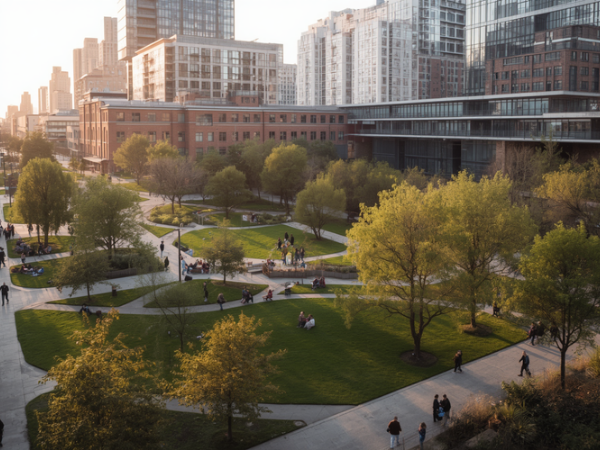
How planning, housing, infrastructure, and neighborhood capacity shape the future of community resilience
Urban development is often discussed in terms of buildings, zoning, housing units, roads, density, and land use. While those issues are important, they only tell part of the story. At its core, urban development is about people. It is about how families live, how neighborhoods function, how residents access opportunity, and how communities prepare for the future.
For the D’Andre D. Lampkin Foundation, urban development is directly connected to community resilience. A resilient community is not only one that can respond after a disaster. It is one that has strong neighborhoods, stable housing, accessible services, reliable infrastructure, safe public spaces, economic opportunity, and residents who feel connected to the decisions shaping their environment.
As cities grow and housing needs increase, communities must find ways to support development while also preserving quality of life. The challenge is not whether communities should grow. Growth is inevitable. The real question is whether growth is planned in a way that strengthens the people and neighborhoods it is meant to serve.
Responsible Growth Requires More Than Housing Production
Housing is one of the most urgent issues facing communities across California and the nation. Families need access to safe, stable, and affordable places to live. Young adults need pathways to remain in the communities where they were raised. Seniors need housing options that allow them to age with dignity. Workers need homes near employment, transportation, schools, and essential services.
But responsible housing policy cannot focus only on the number of units produced. Communities must also consider whether the surrounding infrastructure can support growth.
That includes roads, parking, water systems, public safety services, schools, parks, emergency access, utilities, stormwater systems, and neighborhood-serving resources. When housing is planned without considering these supporting systems, communities may experience increased strain rather than increased resilience.
Urban development should expand opportunity, not create new burdens for residents who are already navigating economic pressure, overcrowding, traffic, infrastructure gaps, or limited access to public services.
Neighborhood Capacity Matters
Every neighborhood has a capacity that extends beyond zoning maps. Neighborhood capacity includes the physical, social, economic, and civic systems that allow a community to function well.
A neighborhood may be able to absorb new housing when infrastructure is strong, public services are accessible, transportation options are available, and residents are engaged in the planning process. Another neighborhood may struggle with growth if it already faces limited street capacity, aging infrastructure, insufficient public space, or weak access to services.
This does not mean communities should resist change. It means planning should be thoughtful, transparent, and grounded in real conditions.
Responsible urban development asks important questions:
How will this project affect traffic and mobility?
Will residents have access to parks, schools, and services?
Can emergency vehicles safely reach the area?
Are utilities and infrastructure prepared for additional demand?
Does the project respect neighborhood character while meeting housing needs?
Are residents being informed, heard, and meaningfully engaged?
Will this development improve long-term community stability?
When these questions are ignored, growth can become a source of tension. When they are addressed honestly, growth can become a tool for resilience.
Urban Development and Community Resilience Are Connected
Community resilience depends on the built environment. The way neighborhoods are designed can either strengthen or weaken a community’s ability to withstand disruption.
A well-planned community can help residents access food, healthcare, transportation, education, employment, recreation, and public safety services. It can reduce isolation, support local businesses, encourage civic participation, and create safer, healthier public spaces.
A poorly planned community can create the opposite effect. It can increase congestion, reduce access to resources, strain infrastructure, isolate vulnerable residents, and make emergency response more difficult.
This is why urban development belongs in conversations about resilience. Housing policy, land use, infrastructure, transportation, public safety, and community engagement are not separate issues. They are all part of the same system.
If we want stronger communities, we must plan for more than buildings. We must plan for people.
Preserving Community Character While Preparing for the Future
One of the greatest challenges in urban development is balancing change with continuity. Communities need to evolve, but they also need to preserve the qualities that make neighborhoods livable, recognizable, and connected.
Community character does not mean preventing progress. It means understanding the identity, history, culture, scale, and lived experience of a neighborhood before making decisions that permanently alter it.
Historic preservation, thoughtful design, public spaces, walkability, tree canopy, local businesses, and neighborhood gathering places all contribute to community identity. When development ignores these elements, residents may feel that growth is happening to them rather than with them.
Responsible planning should invite communities into the process early and often. Residents should not have to learn about major changes only after decisions feel inevitable. Public trust is strengthened when people understand what is being proposed, why it matters, and how their concerns are being considered.
Development Should Expand Opportunity
Urban development should be measured not only by what gets built, but by who benefits.
A stronger development strategy should support:
affordable and attainable housing
economic mobility
small business growth
access to jobs and transportation
safe and healthy neighborhoods
parks and public spaces
educational opportunity
disaster preparedness
environmental sustainability
community connection
When development expands opportunity, it becomes part of the solution. When it deepens displacement, strain, or inequality, it undermines long-term resilience.
The goal should be to create communities where families can live with dignity, young people can see a future, seniors can remain connected, workers can access opportunity, and neighborhoods can grow without losing their foundation.
The Role of Civic Leadership
Responsible urban development requires civic leadership. Elected officials, planning commissioners, city staff, developers, nonprofit leaders, residents, and community partners all have a role to play.
Developers bring investment and vision. Public agencies bring planning authority and regulatory responsibility. Residents bring lived experience. Nonprofits bring community trust and an understanding of human need. Civic leaders must help bring these perspectives together.
Good planning does not happen when one voice dominates the process. It happens when decision-makers are willing to listen, ask better questions, weigh competing needs, and make choices that serve both present and future residents.
Urban development is not only a technical process. It is a civic responsibility.
Building Communities That Can Last
The future of our communities will be shaped by the decisions we make today. Every housing policy, zoning decision, infrastructure investment, and development project becomes part of a larger story about who we are building for and what kind of future we are preparing.
If we want communities that are stronger, healthier, safer, and more resilient, urban development must be guided by more than urgency. It must be guided by wisdom, balance, public trust, and a commitment to long-term community well-being.
Responsible growth is possible. Housing production and neighborhood quality do not have to be opposing goals. With thoughtful planning, meaningful engagement, and a resilience-centered approach, communities can grow in ways that expand opportunity while protecting the people and places that make them strong.
Urban development should not simply change the landscape.
It should help build stronger, more resilient communities.

Leave a Reply
You must belogged in to post a comment.