


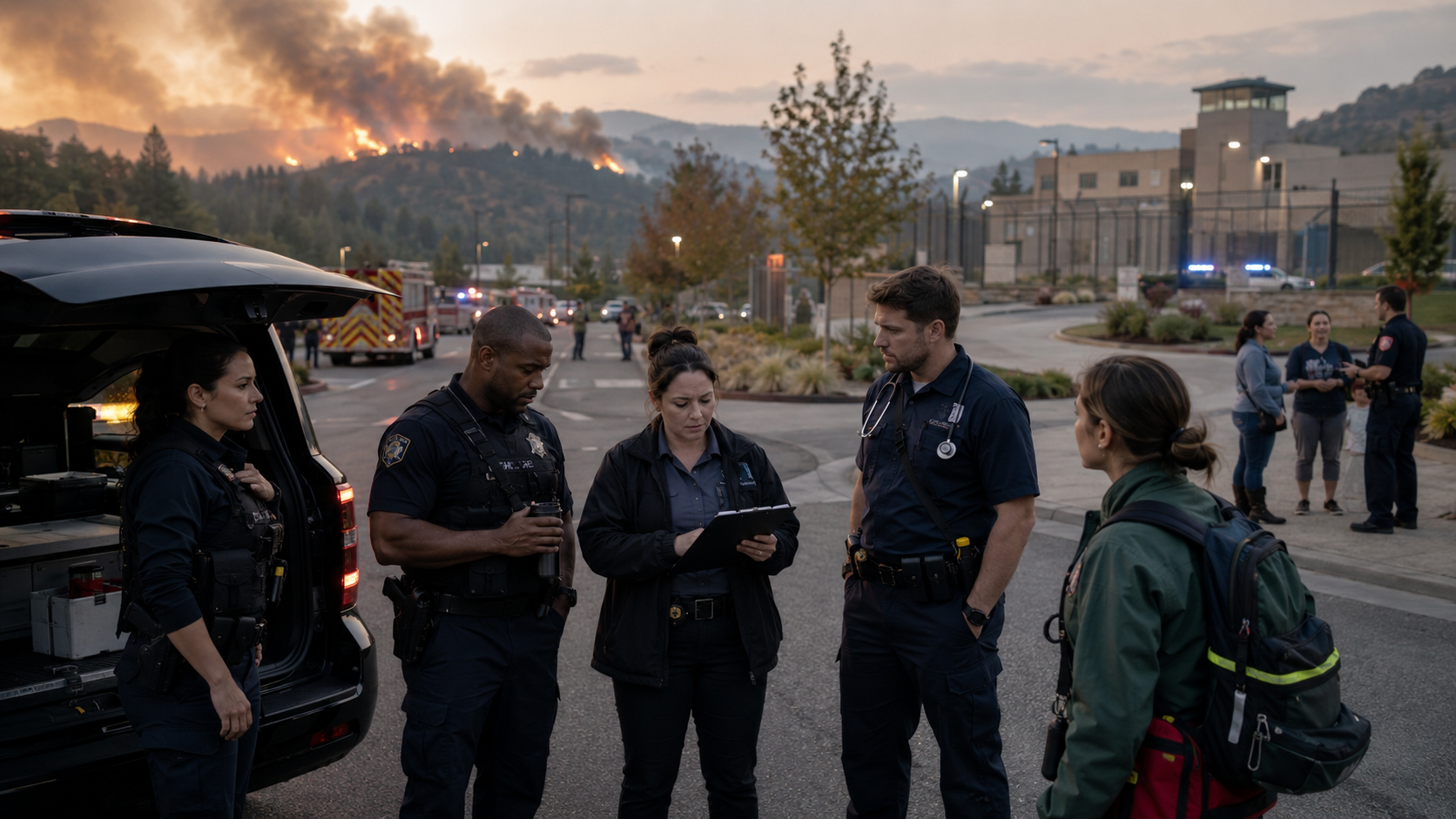
A vacant position on a government organization chart can appear to be an administrative problem. During a wildfire evacuation, jail disturbance, missing-person search, mass-casualty incident, behavioral health crisis, or period of civil unrest, however, that vacancy becomes an operational limitation. It may determine whether an agency can open an emergency command post, deploy sufficient field supervisors, maintain jail security, relieve exhausted personnel, protect evacuation routes, investigate crimes, or continue routine calls for service while responding to a major incident.
For that reason, shortages among deputy sheriffs, police officers, correctional personnel, dispatchers, investigators, analysts, and other public safety professionals should not be understood solely as human-resources challenges. They are threats to local resilience.
The ability of a community to withstand disruption depends partly on whether its institutions can maintain essential services under stress. The Federal Emergency Management Agency places law enforcement, public safety communications, government services, and community safety within the Safety and Security Community Lifeline—the network of services necessary to protect the public and sustain government operations during emergencies (Federal Emergency Management Agency [FEMA], n.d.). A public safety agency may have vehicles, radios, policies, emergency plans, and mutual-aid agreements, but those resources cannot produce operational capacity without qualified people to lead, staff, and sustain the mission.
Staffing, therefore, is public safety infrastructure.
A National Problem with an Uneven Recovery
The national workforce picture is complicated. Some indicators suggest that law enforcement hiring has begun to recover from the steepest losses of the early 2020s. A 2026 survey by the Police Executive Research Forum found that participating agencies hired 17 percent more officers in 2025 than in 2024 and 40 percent more than in 2021. Overall staffing among responding agencies returned to slightly above 2022 levels, while resignations declined compared with their 2021 levels (Police Executive Research Forum [PERF], 2026). These improvements are significant, but they do not mean the workforce crisis has ended. Smaller agencies continued to report more resignations in 2025 than in 2021, retirements increased substantially between 2024 and 2025, and large agencies experienced a much weaker staffing recovery than many medium-sized and smaller departments.
The U.S. Government Accountability Office reached a similarly cautious conclusion. Reviewing national surveys and selected agencies, the GAO found that resignations and retirements generally increased between fiscal years 2019 and 2024, contributing to reductions in officer staffing. Its review also found evidence connecting staffing levels to public safety outcomes, including studies in which increases in local law enforcement staffing were associated with reductions in crime (U.S. Government Accountability Office [GAO], 2026).
Historical vacancy data demonstrate the scale of the underlying challenge. The Bureau of Justice Statistics reported that state and local law enforcement agencies had approximately 64,200 full-time sworn vacancies in the 2020 Law Enforcement Management and Administrative Statistics survey. Those vacancies included approximately 39,500 positions in local police departments, 16,300 in sheriffs’ offices, and 8,400 in primary state law enforcement agencies. During the same reporting period, agencies experienced more full-time sworn separations than hires, and nearly half of the separations were voluntary resignations (Bureau of Justice Statistics [BJS], 2026a). Because these figures describe 2020 rather than current staffing, they should not be interpreted as a present-day vacancy count. They nevertheless illustrate the significant deficit from which many agencies have been attempting to recover.
The replacement burden will remain substantial even where authorized staffing levels are relatively stable. The Bureau of Labor Statistics projects approximately 62,200 openings for police officers and detectives each year between 2024 and 2034. Many of these openings will not result from workforce expansion, but from the need to replace employees who retire, transfer, or leave the occupation (U.S. Bureau of Labor Statistics [BLS], 2025a). Public agencies are therefore competing not only to grow, but also to replace the institutional knowledge that leaves with experienced personnel.
Recruitment numbers also overstate how many candidates ultimately become deployable employees. More than 14 percent of recruits who entered state and local basic law enforcement academies in 2022 did not complete training. Approximately 8 percent were separated involuntarily, 5 percent withdrew voluntarily, and another 1 percent left for other or unknown reasons (BJS, 2024). Applicants must also navigate background investigations, medical and psychological screening, academy training, field training, and probation before they become independent public safety professionals. A hiring announcement, therefore, represents the beginning of a lengthy capacity-building process rather than an immediate solution to a staffing deficit.
Authorized Strength Is Not Operational Strength
Local governments frequently measure staffing by comparing the number of employees with the number of positions authorized in the budget. That comparison is important, but it does not reveal how many people are actually available for deployment.
An agency may appear close to its authorized strength while substantial numbers of employees are attending academies, completing field training, working restricted duty, serving in administrative assignments, taking protected leave, recovering from injuries, appearing in court, or participating in required training. Public safety leaders must therefore distinguish among authorized strength, hired strength, trained strength, and deployable strength.
This distinction becomes especially important during emergencies. A jurisdiction may be able to staff its normal patrol schedule yet lack sufficient depth to support consecutive operational periods, evacuation zones, traffic-control points, security posts, field supervision, an incident command structure, prisoner transportation, and routine calls for service simultaneously. The resilience question is not simply whether an agency can cover an ordinary shift. It is whether it can sustain essential functions when ordinary demand and extraordinary demand occur at the same time.
Staffing Shortages Reduce Emergency Response Capacity
Disasters rarely suspend daily public safety responsibilities. While personnel are assigned to an evacuation, wildfire perimeter, flood response, public demonstration, major event, or emergency operations center, residents continue to report domestic violence, robberies, traffic collisions, missing persons, burglaries, and other urgent incidents. Public safety agencies must manage both the crisis and the baseline service demand.
When staffing is limited, agencies are forced to make operational tradeoffs. Lower-priority calls may remain pending longer. Specialized personnel may be reassigned to basic patrol. Investigative units may lose personnel to emergency deployments. Training may be postponed. Employees may work extended shifts with insufficient recovery time. Mutual aid may fill immediate gaps, but neighboring jurisdictions may be facing the same hazard or staffing constraints.
FEMA’s Community Lifelines framework is useful because it recognizes that Safety and Security is not an isolated service. Law enforcement helps secure shelters, protect critical infrastructure, support search and rescue, manage traffic, preserve evacuation routes, safeguard points of distribution, assist hospitals, and maintain continuity of government. When the public safety workforce is weakened, the effects can spread into transportation, communications, health and medical services, sheltering, and other lifelines (FEMA, n.d.).
Emergency planning must therefore account for personnel endurance, not merely initial deployment. A jurisdiction may be able to mobilize a large force for several hours through overtime and reassignment. Resilience requires the ability to maintain command, relief, documentation, logistics, supervision, and field coverage over multiple operational periods. Without sufficient personnel, the response may become dependent on a shrinking number of employees working increasingly long hours.
Jail and Court Operations Are Part of Community Resilience
The workforce problem is especially consequential for sheriffs’ offices because their responsibilities frequently extend beyond patrol. Many operate county jails, provide court security, transport people in custody, serve civil processes, conduct investigations, and provide law enforcement services to contract cities or unincorporated communities. Staffing pressure in one part of the organization can therefore affect several components of the local justice system.
Jails cannot simply stop operating when staffing falls below desired levels. They require continuous supervision, medical movement, classification, searches, security checks, transportation, emergency response, documentation, and protection of both employees and people in custody. The National Institute of Corrections has characterized correctional staffing levels as critical and has emphasized that recruitment and retention affect outcomes for correctional agencies and the communities they serve (National Institute of Corrections [NIC], 2023).
The replacement challenge in corrections is also substantial. Although total employment of correctional officers and bailiffs is projected to decline between 2024 and 2034, the Bureau of Labor Statistics anticipates approximately 31,900 openings each year, all resulting from workers transferring to other occupations or leaving the labor force. Correctional institutions must operate around the clock, and correctional employees already work in an environment the BLS describes as stressful, dangerous, and vulnerable to high rates of occupational injury and illness (BLS, 2025b).
When custody operations depend on mandatory overtime, repeated callbacks, or reassignment from other functions, the consequences extend beyond employee morale. Persistent shortages can limit programming, increase fatigue, reduce flexibility during disturbances or medical emergencies, complicate transportation and court schedules, and weaken the organization’s ability to respond to a simultaneous community disaster.
Jail staffing is therefore not separate from emergency preparedness. It is a continuity-of-operations requirement.
Behavioral Health Calls Require Both Capacity and Coordination
Public safety agencies are also responding within a changing behavioral health crisis system. For decades, communities frequently relied on 911, emergency medical services, and law enforcement as the default response to mental health and substance-use crises. The expansion of the 988 Suicide & Crisis Lifeline, mobile crisis teams, embedded clinicians, co-response programs, and community responder models is intended to provide a more appropriate range of responses.
The Substance Abuse and Mental Health Services Administration has emphasized that effective crisis systems require collaboration among 988 centers, 911 public safety answering points, law enforcement, emergency medical services, mobile crisis teams, and local behavioral health providers. The objective is to deliver the right response at the right time rather than automatically dispatching law enforcement to every behavioral health incident (Substance Abuse and Mental Health Services Administration [SAMHSA], 2024).
Alternative-response programs can reduce unnecessary police involvement, but they do not eliminate the need for law enforcement capacity. Calls involving violence, weapons, immediate threats, crimes in progress, missing persons, or uncertain safety conditions may still require deputies or police officers. Moreover, alternative systems require their own trained workforce, dispatch protocols, information-sharing agreements, supervision, and sustainable funding.
A resilient model does not frame behavioral health responders and police officers as competing resources. It creates a coordinated continuum in which clinicians, crisis counselors, emergency medical personnel, dispatchers, and law enforcement professionals are used according to the circumstances. This improves service while preserving limited sworn capacity for incidents requiring legal authority or immediate protection.
Community Engagement Is Operational Capacity
One of the least visible effects of understaffing is the erosion of proactive community engagement. When agencies struggle to fill patrol shifts and respond to pending calls, neighborhood meetings, youth programs, community advisory groups, business outreach, school partnerships, foot patrols, problem-oriented policing, and prevention activities can become vulnerable to reassignment or cancellation.
These activities are sometimes described as optional because their results are not always captured through arrests, citations, or response-time statistics. In practice, they build the relationships that public safety agencies rely on during crises. Residents who know local deputies, officers, emergency managers, and community organizations are more likely to share information, follow instructions, report emerging problems, and participate in preparedness efforts.
Community engagement also supports recruitment. Residents who encounter public safety professionals only during enforcement actions receive an incomplete picture of the profession. Youth programs, internships, cadet programs, civilian employment, volunteer opportunities, and sustained neighborhood involvement allow potential applicants to understand public service before entering a formal hiring process.
Staff shortages can therefore create a damaging cycle: reduced staffing weakens engagement; weakened engagement reduces trust and familiarity; diminished trust narrows the future recruitment pool; and a smaller applicant pool further reduces staffing.
The Retention Crisis Can Become Self-Reinforcing
Vacancies do not distribute their workload evenly. The remaining employees absorb more mandatory overtime, missed leave, shift changes, court appearances, emergency callbacks, and secondary assignments. Those conditions can increase fatigue and burnout, which may lead to additional resignations, injuries, absenteeism, or early retirement.
A systematic review of 41 studies found that organizational and operational conditions were the most prominent risk factors associated with burnout among police officers. The authors concluded that agencies should devote greater attention to officer mental health and to reducing adverse organizational conditions rather than treating burnout only as an individual coping failure (Alves et al., 2023).
More recent longitudinal research reinforces the connection between burnout and actual employee departures. Hassan and colleagues examined survey and employment records from sworn officers and found that higher burnout was associated with a greater probability of resignation. Public service motivation was associated with a lower probability of leaving and appeared to reduce some of the resignation pressure associated with burnout (Hassan et al., 2026). The implication is important: agencies benefit from recruiting people motivated by service, but a sense of mission cannot indefinitely compensate for harmful working conditions.
Wellness resources have expanded, but access remains uneven. According to a nationally representative BJS survey, 60 percent of general-purpose law enforcement agencies offered at least one formal wellness program in 2022. Among agencies employing 100 or more full-time-equivalent sworn personnel, 93 percent offered at least one such program; among smaller agencies, the figure was 57 percent. The same study found that 82 percent of agencies had no full-time personnel assigned to a formal wellness program (BJS, 2026b).
Peer support and counseling are valuable, but retention cannot be solved by wellness programming alone. An organization cannot ask employees to manage stress individually while leaving excessive workload, inconsistent supervision, chronic schedule disruption, inadequate training, or perceived unfairness unaddressed. Workforce wellness must include organizational health.
Recruitment Must Be Faster Without Becoming Less Rigorous
Public safety agencies should modernize hiring processes, but modernization should not be confused with lowering professional standards. Background investigations, medical and psychological screening, academy requirements, integrity standards, and field training protect the public, the agency, and future employees.
The more appropriate objective is to remove avoidable delay and confusion. Applicants should receive clear information, timely communication, realistic expectations, and consistent guidance throughout the process. Agencies should examine how many qualified candidates are lost because of lengthy scheduling gaps, duplicative paperwork, unexplained silence, or an inability to navigate multiple stages while maintaining other employment.
The U.S. Department of Justice has recommended that agencies reconsider whether eligibility requirements accurately reflect modern police work, accelerate hiring procedures, invest in employee health and safety, and partner with community leaders to reach qualified candidates who might not otherwise consider law enforcement careers (U.S. Department of Justice [DOJ], 2023).
Recruitment should also be treated as a long-term local pipeline rather than an occasional advertising campaign. Effective approaches can include paid internships, cadet and explorer programs, public safety career academies, partnerships with colleges, military-transition outreach, civilian entry positions, tuition assistance, and structured mentoring. Recruitment materials should accurately represent the profession’s complexity: emergency response, constitutional policing, communication, crisis intervention, problem-solving, report writing, technology, investigation, and community partnership.
A realistic presentation may attract fewer impulsive applicants, but it can produce candidates whose expectations are more closely aligned with the work.
Retention Requires More Than Compensation
Competitive compensation matters, particularly in regions where neighboring agencies draw from the same applicant pool. Yet salary and bonuses cannot overcome every organizational problem. Employees also evaluate supervision, schedule predictability, workload, promotional fairness, training opportunities, family impacts, professional development, equipment, organizational integrity, and whether leaders appear to value their service.
Retention strategies should therefore begin with direct evidence. Agencies should conduct confidential stay interviews before employees announce their departure, examine resignation and retirement patterns by assignment and supervisor, measure mandatory overtime, identify stages where recruits or trainees are lost, and review whether employees can realistically use earned leave.
First-line supervisors deserve special attention. Sergeants and comparable supervisors shape daily working conditions more directly than executive statements or recruitment campaigns. They influence workload distribution, communication, recognition, accountability, psychological safety, and whether employees believe organizational procedures are fair.
Retention must also include family resilience. Disasters, extended deployments, civil unrest, and special events place demands on employees’ households. Childcare options, family preparedness resources, schedule communication, post-incident support, and predictable relief practices help employees remain available during emergencies without forcing them to choose between public duty and unresolved family safety concerns.
Building a Public Safety Workforce Resilience Strategy
A resilience-based approach changes how local governments define the problem. The question is no longer simply, “How many vacancies do we have?” It becomes, “Which essential functions become unstable when personnel are unavailable, and how quickly can we restore those functions?”
First, agencies should measure deployable capacity. Authorized positions, vacancies, academy recruits, employees in field training, long-term absences, restricted-duty personnel, overtime, leave cancellation, and supervisor-to-employee ratios should be evaluated together.
Second, staffing studies should be workload-based rather than driven only by population, historical budgets, or comparisons with neighboring agencies. Calls for service, response priorities, investigative caseloads, jail obligations, court requirements, geographic coverage, special events, disaster risks, training mandates, and community-engagement expectations all contribute to workload.
Third, jurisdictions should identify duties that require sworn authority and those that can be performed effectively by professional staff or partner organizations. Civilian investigators, analysts, evidence technicians, community service officers, behavioral health professionals, report specialists, and administrative personnel can preserve sworn capacity without weakening accountability. Civilianization should not become a mechanism for transferring unreasonable workloads to another understaffed workforce; it must be supported by proper training, staffing, compensation, and supervision.
Fourth, continuity plans should include workforce degradation scenarios. Agencies regularly plan for earthquakes, wildfires, floods, cyberattacks, and civil disorder, but they should also exercise what happens when a significant portion of the workforce is unavailable, when neighboring agencies cannot provide immediate mutual aid, or when an incident lasts longer than the initial deployment model.
Finally, local leaders should protect the activities that create future capacity: recruitment, academy instruction, field training, leadership development, wellness, after-action learning, community engagement, and emergency exercises. Eliminating these functions to cover today’s vacancies may produce a temporary staffing gain while worsening tomorrow’s shortage.
Conclusion: The Workforce Is the Capability
Public safety staffing shortages are often discussed through vacancy rates, hiring incentives, pension costs, or recruitment advertisements. Those issues matter, but they are incomplete. The deeper question is whether communities possess sufficient human capacity to protect residents, operate jails, respond to behavioral health emergencies, investigate crimes, maintain public trust, support disaster operations, and continue essential services when demand rises suddenly.
A modern vehicle does not patrol without a deputy or police officer. An emergency operations plan does not implement itself. A jail cannot maintain safety through policy alone. A mutual-aid agreement is only useful when another agency has personnel available to send. Technology may improve efficiency, but it cannot replace judgment, leadership, lawful authority, communication, empathy, or the ability to adapt under pressure.
The future of local resilience will therefore depend on whether communities treat recruitment and retention as strategic public safety responsibilities. That means maintaining rigorous standards while modernizing hiring, creating credible local career pipelines, strengthening supervision, reducing avoidable organizational stress, coordinating alternative responders, preparing employee families, and measuring the workforce according to the functions it must sustain.
Staffing shortages are not merely signs of an agency struggling to fill jobs. They are warnings that a community may be losing the capacity to absorb disruption. Public safety resilience begins by recognizing that the workforce is not one resource among many.
The workforce is the capability.
References
Alves, L., Abreo, L., Petkari, E., & Pinto da Costa, M. (2023). Psychosocial risk and protective factors associated with burnout in police officers: A systematic review. Journal of Affective Disorders, 332, 283–298. doi:10.1016/j.jad.2023.03.081.
Bureau of Justice Statistics. (2024). State and local law enforcement training academies and recruits, 2022: Statistical tables. U.S. Department of Justice, Office of Justice Programs.
Bureau of Justice Statistics. (2026a). Hiring and retention of state and local law enforcement officers, 2020: Statistical tables. U.S. Department of Justice, Office of Justice Programs.
Bureau of Justice Statistics. (2026b). Health and wellness resources available to law enforcement, 2022. U.S. Department of Justice, Office of Justice Programs.
Federal Emergency Management Agency. (n.d.). Community lifelines. U.S. Department of Homeland Security.
Hassan, S., Wright, B. E., Baluran, D. A., & Baker, D. B. (2026). Motivation, burnout, and resignation: A longitudinal study of law enforcement officers. Review of Public Personnel Administration. Advance online publication. doi:10.1177/0734371X261419150.
National Institute of Corrections. (2023). Recruitment, hiring, and retention. U.S. Department of Justice, Federal Bureau of Prisons.
Police Executive Research Forum. (2026). PERF national survey shows police staffing rebounds to its 2022 level as agencies employ new hiring strategies.
Substance Abuse and Mental Health Services Administration. (2024). Crisis systems coordination and collaboration: Leveraging strengths and opportunities of 988 and 911. U.S. Department of Health and Human Services.
U.S. Bureau of Labor Statistics. (2025a). Police and detectives. Occupational Outlook Handbook. U.S. Department of Labor.
U.S. Bureau of Labor Statistics. (2025b). Correctional officers and bailiffs. Occupational Outlook Handbook. U.S. Department of Labor.
U.S. Department of Justice. (2023). Recruitment and retention for the modern law enforcement agency. Office of Community Oriented Policing Services and Bureau of Justice Assistance.
U.S. Government Accountability Office. (2026). Law enforcement officers: Observations on recruitment and retention at the federal, tribal, state, and local levels (GAO-26-108495).

Leave a Reply
You must belogged in to post a comment.