


How a whole-community approach helped address sheltering, transportation, safety, family support, and local recovery needs
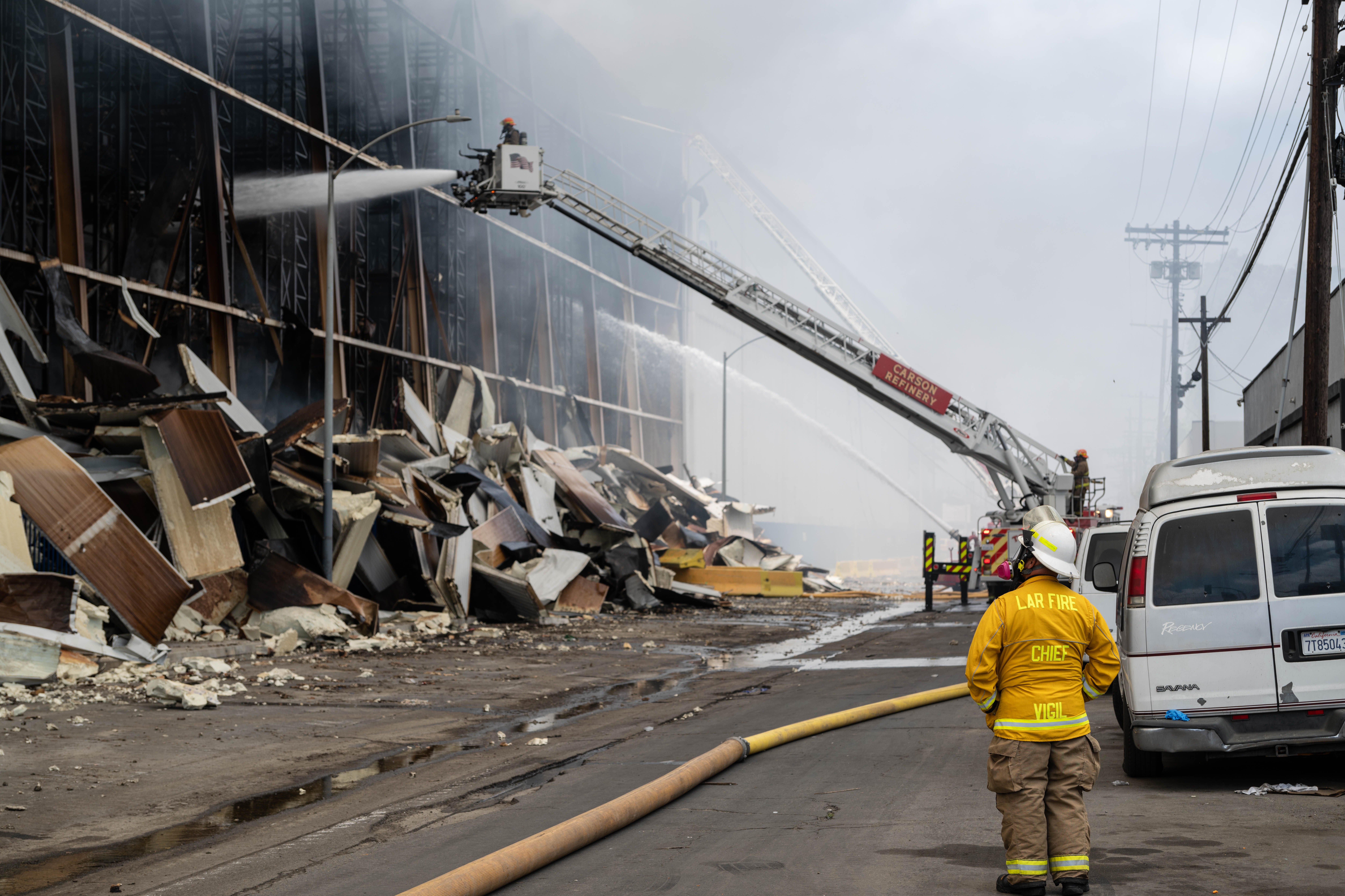
The structure fire at the Lineage Logistics cold-storage warehouse in Boyle Heights offers a powerful case study in how modern disaster response extends far beyond fire suppression. What began as a hazardous warehouse fire quickly became a complex community-stabilization challenge involving air quality concerns, traffic disruption, sheltering needs, family support, public safety, private-sector responsibility, food logistics, and intergovernmental coordination.
News coverage described the incident as a massive fire at a cold-storage facility in Boyle Heights near downtown Los Angeles. Early reports noted shelter-in-place orders due to hazardous air, concerns involving ammonia, heavy smoke, and the challenges of fighting a fire at a large, heavily insulated warehouse with solar panels on the roof. As the incident continued, reporting emphasized the complexity of extinguishing a cold-storage fire, including the size of the facility, the presence of tens of millions of pounds of frozen food, structural hazards, and air quality impacts on surrounding communities.
Although the emergency occurred within the City of Los Angeles, the response demonstrated an important principle of the National Response Framework: disasters are rarely solved by one jurisdiction, one department, or one discipline alone. They require coordination across government, nonprofit organizations, private industry, community institutions, and residents. In practice, the Boyle Heights incident became an example of the whole-community approach in action.
The National Response Framework and Whole-Community Response
The National Response Framework, commonly known as the NRF, provides the guiding structure for how the United States responds to disasters and emergencies. It is built on principles such as engaged partnership, tiered response, scalable and adaptable capabilities, unity of effort, and readiness to act. The framework is intended to support coordination among local, state, federal, private-sector, nonprofit, and community partners before, during, and after emergencies.
The Boyle Heights warehouse fire illustrates why this framework matters. A fire department can suppress flames. A transportation agency can support road closures. A sheltering organization can assist displaced residents. Law enforcement can provide public safety and security. Parks staff can support site operations and community programming. Public works personnel can address streets and access. County Disaster Service Workers can help fill staffing and support needs. Private industry can provide food and logistical support. But without coordination, these efforts can remain fragmented.
The NRF helps explain why a successful response requires more than technical expertise. It requires a structure capable of aligning many different capabilities toward a shared set of community-centered objectives.
A City Incident With Regional Consequences
The fire occurred in Boyle Heights, a community within the City of Los Angeles. Yet the consequences did not remain neatly within one jurisdictional boundary. Smoke, odor, air quality concerns, traffic disruption, evacuee needs, food support, and shelter operations created impacts that required regional coordination.
This is where the principle of tiered response becomes important. Under the NRF, incidents are generally managed at the lowest possible jurisdictional level, but additional capabilities may be brought in as the scope, complexity, or duration of the incident grows.
The use of City Terrace Park as a shelter location is an important example. City Terrace Park is operated by the Los Angeles County Department of Parks & Recreation, yet it became part of the support structure for people affected by an emergency that originated within the City of Los Angeles. That operational decision reflects a practical reality of disaster response: the best available resource may not always sit within the same jurisdiction where the hazard began.
In a whole-community response, geography matters, but capability matters too. If a county-operated park can provide a safe, accessible, and appropriate shelter environment, then it becomes part of the response network.
Mass Care: Shelter as More Than a Building
The American Red Cross, a nonprofit organization, reportedly established a shelter at City Terrace Park to support residents affected by the fire. This aligns closely with the NRF’s Emergency Support Function framework. Under the NRF, Emergency Support Function #6 addresses mass care, emergency assistance, temporary housing, and human services. The Red Cross has long played a central role in sheltering and mass care coordination, and FEMA and the American Red Cross jointly developed the National Shelter System to support shelter planning and operations.
A shelter, however, is not simply a place where people sleep. In a community-centered disaster response, a shelter becomes a temporary support hub. It may provide safety, information, food, referrals, emotional reassurance, accessibility support, family services, and connection to recovery resources.
In the Boyle Heights response, the shelter function appears to have extended beyond basic displacement support. Los Angeles County Sheriff’s Department personnel provided security and checked on the well-being of evacuees. Los Angeles County mobilized Disaster Service Workers from a variety of disciplines, including Public Works, the Department of Children and Family Services, and the Department of Aging. That diversity matters because disaster survivors do not arrive with only one kind of need.
A family may need shelter, but also child support. A senior may need transportation or accessibility assistance. A parent may need a safe place for children during work hours. A resident may need reassurance, translation, health information, or help understanding next steps. A whole-community approach recognizes that the human consequences of disaster are multi-dimensional.
Public Safety and Shelter Security
Shelter operations require safety, trust, and order. The Los Angeles County Sheriff’s Department’s role in providing security and checking on evacuee well-being illustrates the public safety dimension of mass care.
Public safety in this context is not simply enforcement. It is reassurance, presence, problem-solving, and protection of a vulnerable temporary environment. Shelters may include families, children, older adults, people with disabilities, residents experiencing stress, and individuals who may be uncertain about whether they can return home. A visible and appropriate public safety presence can help stabilize the environment and allow shelter staff and nonprofit partners to focus on care and service delivery.
This aligns with the NRF’s broader concept of unity of effort. Agencies retain their own authority and responsibilities, but work together toward shared incident objectives.
Disaster Service Workers and the Value of Cross-Disciplinary Staffing
One of the most important lessons from the Boyle Heights response is the value of cross-disciplinary staffing. Los Angeles County reportedly mobilized Disaster Service Workers from multiple departments, including Public Works, Children and Family Services, and Aging.
This is a strong example of scalable and adaptable capability. Not every disaster need requires the same type of responder. Some needs are logistical. Some are social. Some are operational. Some involve children, seniors, infrastructure, roadways, or information sharing.
The presence of Disaster Service Workers from different disciplines reflects a mature understanding of disaster operations: emergencies create cascading human and infrastructure needs. The ability to draw from multiple departments allows a jurisdiction to respond with more than one tool.
In practice, this means a shelter can become more than a facility managed by one organization. It can become a coordinated support environment where public agencies, nonprofit partners, and volunteers help address the practical realities of displacement.
Transportation, Roads, and Access
The Boyle Heights fire also demonstrates the importance of transportation and public works in disaster response. Both the Los Angeles Department of Transportation and Los Angeles County Public Works reportedly deployed personnel to address traffic and roadway blockages in the affected area.
This is significant because road access is a life-safety and continuity issue. Road closures and traffic control affect emergency vehicle access, resident evacuation or movement, delivery of supplies, access to businesses, and the ability of workers and families to navigate daily life during an incident. When smoke, firefighting equipment, blocked streets, debris, and public safety perimeters converge, transportation coordination becomes essential.
Under the NRF structure, transportation, public works, public safety, logistics, mass care, and public information are not isolated functions. They are interdependent. A shelter cannot function well if evacuees cannot reach it. Food vendors cannot support affected residents if access routes are blocked. Public safety cannot maintain order without clear traffic control. Public works cannot resolve roadway issues without coordination with incident command and transportation agencies.
Private-Sector Responsibility and Community Support
The private sector also played an important role. Local food vendors hired by the owners of the company where the fire occurred, Lineage Logistics, reportedly helped provide food support. This is a practical example of how private-sector participation can support response and stabilization when a business-related incident affects surrounding residents.
News coverage reported that Lineage Logistics operated the cold-storage facility and that the warehouse contained tens of millions of pounds of frozen food products. Reports also described ongoing concerns about smoke, odor, cleanup, and impacts to nearby residents.
When a private facility becomes the source of a community-impacting emergency, responsibility cannot be limited to property lines. A whole-community approach recognizes that private-sector actors may need to support the response, communicate with public agencies, assist affected residents, and contribute to recovery.
Hiring local food vendors is also important from a community development perspective. It can provide culturally relevant support, keep resources circulating locally, and involve businesses that understand the community. In a disaster environment, food is not only a logistical item. It is a stabilizing resource.
Parks as Community Resilience Infrastructure
One of the most instructive elements of the response was the use of parks and recreation resources. City Terrace Park served as a shelter site, but parks staff also reportedly provided programming for children who were out of school for the summer and needed a safe place to recreate away from affected homes or regular daycare locations while parents were at work.
This is a critical resilience lesson. Parks are often viewed as recreational amenities, but during emergencies they can become community resilience infrastructure. They can serve as shelters, cooling centers, distribution sites, family support hubs, public information points, volunteer staging areas, and safe spaces for children.
Children are often overlooked in disaster operations. Yet displacement, school disruption, poor air quality, parental work obligations, and uncertainty can create serious stress for young people. Providing structured activities and safe recreation is not secondary to disaster response. It is part of restoring stability.
In this case, Parks & Recreation staff helped address a real social need: children needed a safe environment while adults managed work, housing uncertainty, health concerns, and recovery logistics. This reflects the whole-community principle that effective response must account for the lived realities of families.
Environmental Justice and Community Trust
The Boyle Heights fire also raises broader questions about environmental justice, industrial land use, and public trust. Reporting noted community concerns about smoke, odors, health impacts, hazardous materials, and the concentration of industrial risks in vulnerable communities.
These concerns are not separate from emergency management. They are central to it. A disaster response that provides shelter but fails to communicate clearly about health risks will struggle to maintain trust. A response that manages road closures but does not address residents’ fears about air quality will be incomplete. A recovery process that focuses only on extinguishment and cleanup, while ignoring long-term community impacts, will miss the deeper resilience challenge.
The National Disaster Recovery Framework emphasizes coordination, stakeholder engagement, local recovery capacity, health and social services, housing, infrastructure, and community planning. Although the immediate fire response may fall under response doctrine, the aftermath quickly moves into recovery questions: What did residents lose? What health concerns remain? How will cleanup be conducted? How will information be shared? How will trust be restored? How will future risk be reduced?
Lessons for Emergency Management
The Boyle Heights warehouse fire offers several lessons for emergency management professionals, public agencies, nonprofit organizations, and community leaders.
First, emergencies should be understood as community events, not merely technical incidents. Fire suppression was essential, but so were sheltering, security, traffic control, food support, child programming, public information, and recovery coordination.
Second, jurisdictional boundaries should not prevent operational cooperation. A City of Los Angeles incident relied in part on Los Angeles County resources, including a county-operated park and county personnel. That is not a failure of jurisdiction. It is an example of regional capability being applied to community need.
Third, nonprofit organizations remain essential to disaster response. The Red Cross shelter function demonstrates why voluntary organizations are central to mass care and why public agencies must maintain strong relationships with nonprofit partners before disaster strikes.
Fourth, public safety agencies play important roles beyond enforcement. Shelter security, welfare checks, reassurance, and coordination are part of stabilizing disaster-affected communities.
Fifth, private-sector actors must be integrated into response and recovery planning. When a private facility creates public impacts, private resources and responsibility should be part of the solution.
Finally, parks, recreation staff, and community facilities should be recognized as resilience assets. Their role in sheltering and child programming demonstrates how local public spaces can support families during complex emergencies.
Conclusion: A Whole-Community Model in Practice
The Boyle Heights warehouse fire was not only a structure fire. It was a mass care, public health, transportation, public safety, family support, private-sector accountability, and community resilience incident.
The response demonstrates how the National Response Framework’s whole-community principles can be applied in real conditions. A nonprofit sheltering partner, a county park, sheriff’s personnel, county Disaster Service Workers, public works staff, transportation agencies, private-sector food support, and parks programming all contributed to a broader effort to stabilize affected residents.
This is what modern emergency management requires. It is not enough to extinguish the hazard. Communities must also be supported through disruption, displacement, uncertainty, and recovery.
The lesson is clear: resilient communities are built when agencies, nonprofits, businesses, public servants, volunteers, and residents understand that disaster response is a shared responsibility.
When the whole community is engaged, response becomes more than reaction.
It becomes recovery in motion.

Leave a Reply
You must belogged in to post a comment.