


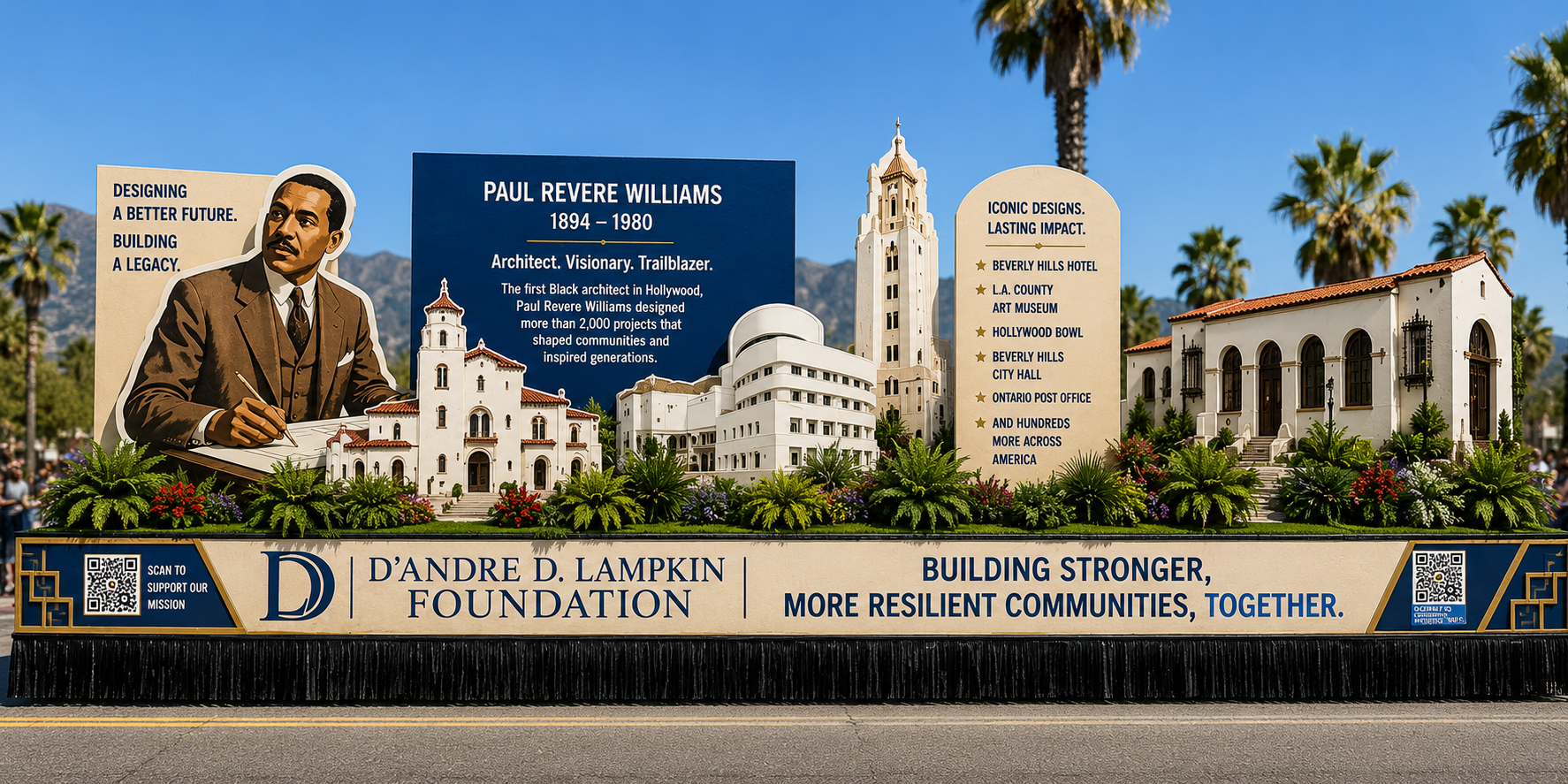
Ontario, California — July 2026
Some of the most meaningful community projects begin with a simple question.
“What if we could tell a story in a way people have never experienced before?”
That question became the inspiration behind the D’Andre D. Lampkin Foundation’s award-winning tribute to legendary architect Paul Revere Williams during the 2026 City of Ontario Independence Day Parade.
What began as a conversation about honoring Williams’ extraordinary architectural legacy soon evolved into a project that combined historical research, digital design, traditional craftsmanship, volunteer service, and community partnerships to create an educational exhibit unlike anything the Foundation had attempted before.
The result was a float that received the Chaffey Heritage Award, but the journey to that moment was every bit as meaningful as the recognition itself.
A Vision Begins
The Foundation wanted to celebrate two important milestones.
The first was America’s 250th Birthday, recognizing the nation’s enduring commitment to freedom, opportunity, and civic responsibility.
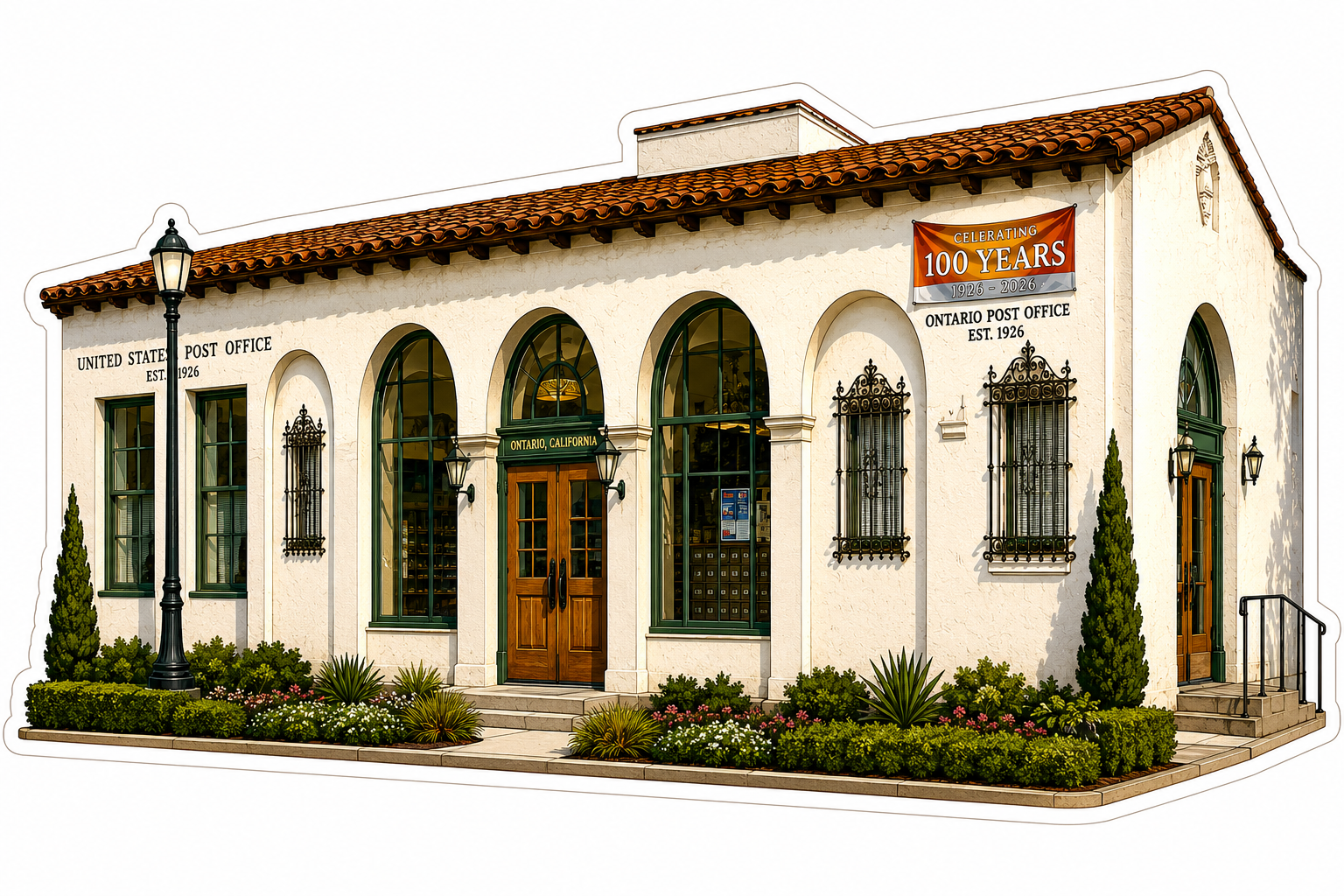
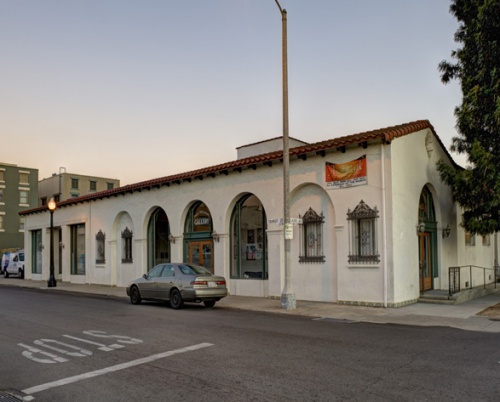
The second was the 100th anniversary of Ontario’s historic Post Office, one of the many remarkable buildings designed by Paul Revere Williams.
Rather than creating a traditional parade float focused primarily on decoration, the Foundation envisioned something different—an educational exhibit that would introduce parade attendees to one of America’s most influential architects while highlighting Ontario’s own architectural heritage.
Turning Ideas into Design
The first challenge was transforming an idea into something tangible.
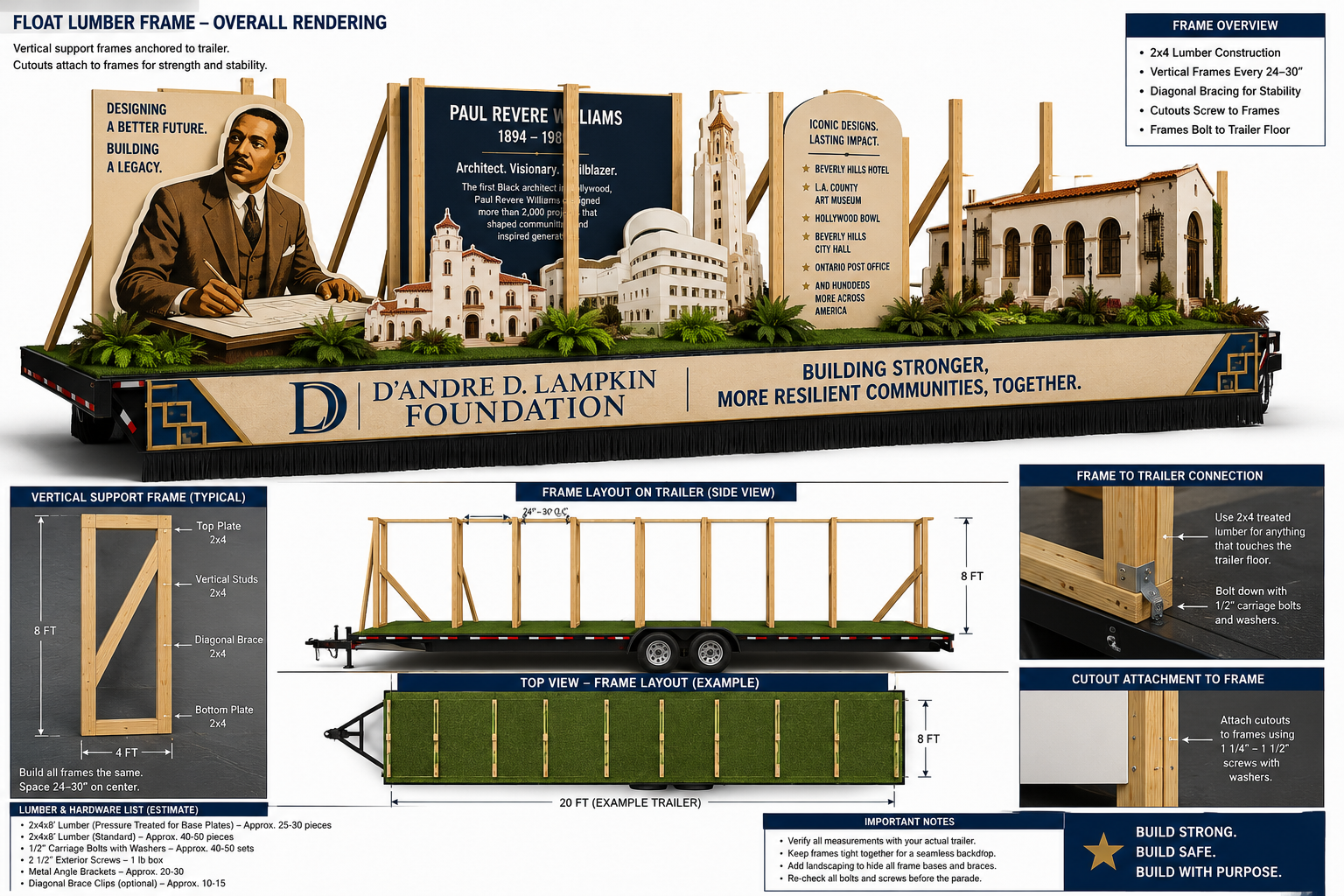
Digital design tools were used to explore concepts, test layouts, refine colors, and visualize how individual architectural elements might come together on a moving exhibit. Those early renderings helped answer practical questions long before the first piece of lumber was cut.
Could a portrait of Paul Revere Williams become the centerpiece?
Which buildings would best represent his legacy?
How could educational panels be incorporated without overwhelming the overall design?
Working through these questions digitally made it possible to refine the concept efficiently while preserving flexibility throughout the creative process.
Technology did not replace creativity. It supported it.
From Screen to Structure
Once the design was finalized, attention shifted from imagination to construction.
Large-format architectural illustrations were professionally produced, lumber was cut and assembled into structural supports, and volunteers worked together to transform individual components into a cohesive educational display.
Every stage required problem-solving.
Wind resistance had to be considered.
Mounting systems had to be designed.
Materials had to be sourced under a compressed timeline.
Construction details were adjusted repeatedly as the exhibit took shape.
What had existed only as a digital concept days earlier gradually became a physical exhibit that visitors could experience in person.
A Community Builds Together
Innovation alone could never have completed the project.
The float became possible because people stepped forward.
Community volunteers donated their time and talents.
Local businesses provided expertise, materials, and encouragement.
Friends, neighbors, and supporters contributed wherever they could.
Each person added another piece to the story.
The finished float reflected not only the legacy of Paul Revere Williams but also the collaborative spirit of the community it was designed to celebrate.
Education on Wheels
As the parade moved through Ontario, something remarkable happened.
Families paused to read the educational displays.
Children pointed to the buildings and asked questions.
Residents recognized familiar landmarks.
Conversations began about architecture, local history, and the people whose vision helped shape the city.
The float had become exactly what the Foundation hoped it would become:
A traveling classroom.
History was no longer confined to museums or books.
It was rolling down Main Street.
Building Resilience Through Innovation
Community resilience is often associated with disaster preparedness, emergency response, and recovery.
Those remain essential components of resilience.
But resilience is also strengthened when communities preserve their history, celebrate shared accomplishments, educate future generations, and create opportunities for neighbors to learn together.
Innovation made this project possible.
Partnerships brought it to life.
Education gave it lasting purpose.
Together, those elements transformed an idea into an award-winning community experience.
That is resilience in action.
Looking Ahead
The Foundation views this project as more than a successful parade entry.
It serves as a reminder that meaningful community engagement often begins with curiosity, grows through collaboration, and succeeds because people are willing to contribute their ideas, talents, and time.
As the Foundation continues expanding its work in disaster preparedness, youth leadership, historic preservation, and community resilience, the lessons learned through this project will continue to guide future initiatives.
Because every strong community begins with a vision.
And every lasting vision becomes stronger when people build it together.

Leave a Reply
You must belogged in to post a comment.