


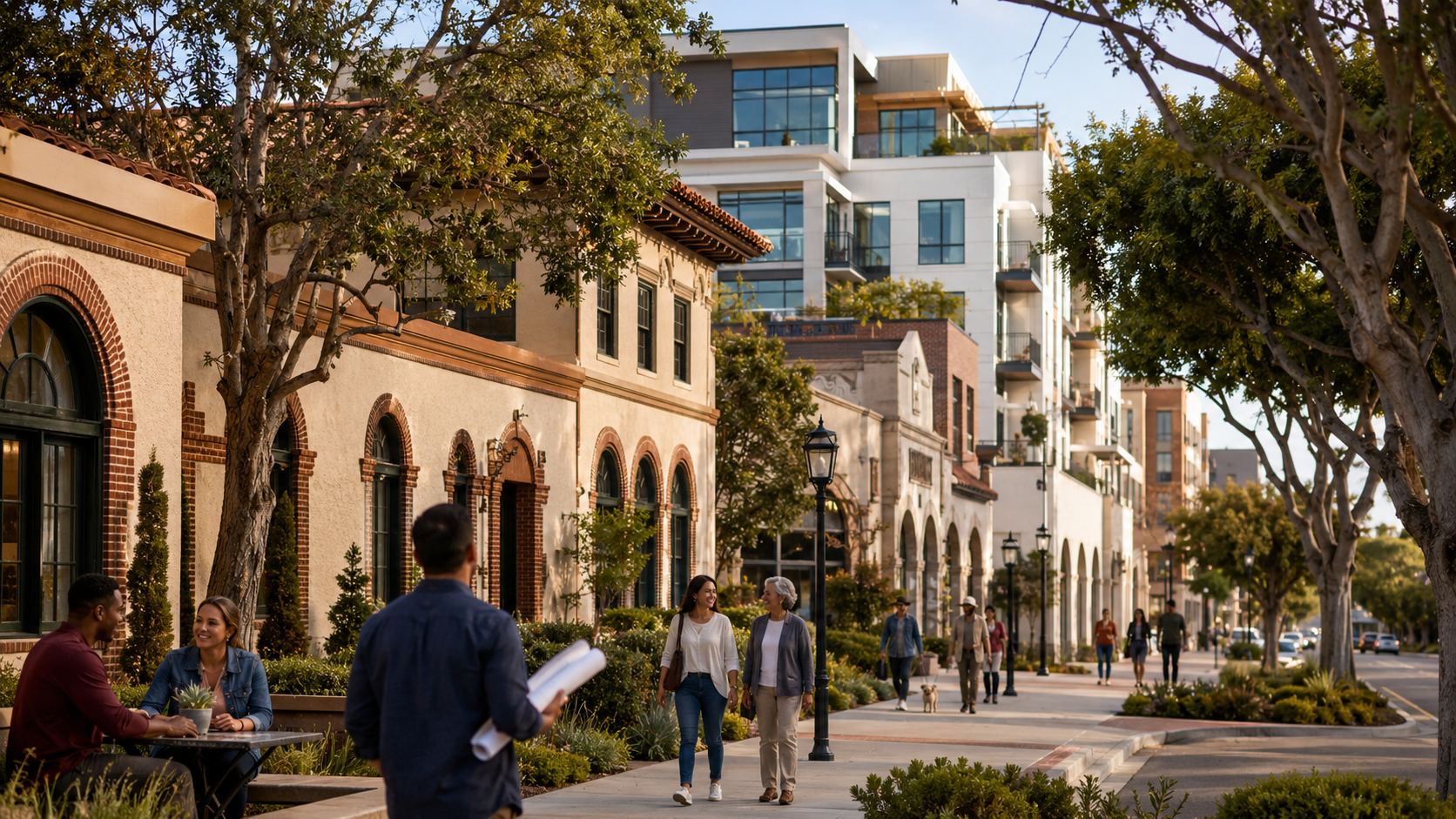
Historic Preservation and Community Resilience: Protecting Memory While Planning for Growth
Cities are never static. They grow, redevelop, absorb new populations, respond to economic pressures, and adapt their physical environments to meet changing needs. Housing must be built. Infrastructure must be modernized. Commercial corridors must evolve. New industries require space, and neighborhoods that once occupied the edges of metropolitan regions may eventually find themselves at the center of development pressure.
Yet cities are also repositories of memory.
Their historic homes, agricultural landscapes, commercial districts, civic buildings, religious institutions, public spaces, and neighborhood patterns tell the story of how communities came to be. These places help residents understand not merely where they live, but what their community has valued, endured, created, and passed from one generation to the next.
The tension between these two realities—growth and preservation—is often framed as a conflict. Development is portrayed as forward-looking, while preservation is characterized as resistance to change. That framing is increasingly inadequate.
Historic preservation is not inherently anti-growth. At its best, preservation is a form of responsible urban development: one that allows communities to evolve without unnecessarily erasing the physical and cultural foundations of their civic identity.
This principle has become increasingly relevant to my own work as a member of the Ontario Planning Commission. Planning commissioners routinely confront questions that extend beyond whether a particular project can physically be built. We must also consider how development fits within a larger community vision, how land-use decisions affect surrounding neighborhoods, and how individual decisions collectively shape the city future generations will inherit.
The challenge is therefore not to choose between preservation and progress. The goal is to create a planning framework in which responsible development and community preservation reinforce one another rather than compete. It is to determine how communities can accommodate necessary change while protecting the places, relationships, and stories that make growth meaningful.
Historic Preservation as Part of the Planning Process
Historic preservation is sometimes understood narrowly as the protection of architecturally distinguished buildings. Modern preservation practice, however, encompasses a much broader understanding of cultural resources. Historic districts, landscapes, transportation corridors, agricultural properties, industrial sites, neighborhood institutions, and places associated with culturally significant events may all contribute to a community’s identity.
The National Park Service describes preservation planning as a systematic process through which communities establish priorities for protecting historic and cultural resources and integrate those priorities into broader decision-making (National Park Service, n.d.). The National Historic Preservation Act similarly emerged from growing recognition that the places communities inherit contribute to identity, quality of life, and economic vitality (National Park Service, 2023).
Ontario has incorporated this principle into its own planning framework. The City’s Historic Preservation Program is intended to protect significant architectural, historical, and cultural resources reflecting Ontario’s distinctive heritage, and the city has participated in the federal Certified Local Government program since 2003 (City of Ontario, n.d.). The broader vision expressed through The Ontario Plan also recognizes the importance of maintaining the community’s distinctive character as growth and change occur (City of Ontario, n.d.).
These policies illustrate an important point: preservation is not separate from planning.
It is planning.
Planning determines which parts of a community will change, how quickly that change will occur, and what values will guide the transformation. Historic preservation introduces another necessary question into that process:
What should remain?
A city that answers only the question of what should be built risks losing sight of what has already been built—socially, culturally, and physically—over generations.
Community Resilience Requires Continuity
Community resilience is frequently discussed in terms of infrastructure, emergency preparedness, economic capacity, and institutional strength. These dimensions are essential. But resilience also depends on continuity.
People develop relationships with places. Streets, parks, businesses, schools, historic buildings, places of worship, and neighborhood landmarks become reference points through which residents understand their community and their relationship to it. Research on place identity demonstrates that the connection between people and place is multidimensional, incorporating memory, belonging, social relationships, physical environments, and shared meaning (Strandberg & Styvén, 2024).
Historic places can therefore function as anchors of continuity during periods of rapid change.
This does not mean that every older structure must be preserved indefinitely. Cities cannot function as museums. Buildings deteriorate. Economic needs change. Infrastructure becomes obsolete. Housing shortages require new construction. Communities themselves evolve.
The resilience question is not whether change should occur.
The question is whether change occurs in a way that allows a community to recognize itself afterward.
Research examining historic preservation and disaster planning has similarly argued that historic resources can contribute to community resilience and that preservation should be more deliberately integrated into resilience planning (Appler & Rumbach, 2016). Historic resources often serve not only as physical assets but as recognizable landmarks around which communities organize their collective memory and recovery.
The same principle applies outside disaster recovery.
Rapid development can also create forms of community disruption when familiar landscapes disappear faster than residents can process the change. Neighborhoods may remain economically productive while becoming increasingly disconnected from their historical identity. When this occurs, development can generate a sense that growth is something happening to a community rather than something occurring with it.
Preservation can provide continuity within that transformation.
Neighborhood Identity Is an Urban Asset
Neighborhood identity is difficult to quantify, but its effects are visible.
Residents often identify communities through distinctive architecture, street patterns, mature landscapes, longstanding institutions, local businesses, gathering places, and historical associations. Collectively, these characteristics create a sense of place.
Research on heritage conservation in areas undergoing urban renewal has found that large-scale redevelopment can disrupt local character and social networks, while thoughtful heritage conservation can strengthen community identity and sense of place (Yung, Zhang, & Chan, 2017).
This matters because successful communities require more than functional buildings.
They require attachment.
A neighborhood where residents feel connected to place may be more likely to sustain civic participation, institutional relationships, local traditions, and stewardship. Conversely, when residents believe that the physical evidence of their community’s history can disappear without meaningful consideration, distrust can emerge even when individual development proposals comply with technical regulations.
This is one reason historic preservation should not be reduced to aesthetic nostalgia.
A historic property may matter because of its architecture. But another place may matter because generations gathered there, because a significant community institution operated there, because it represents an agricultural or industrial era, or because it tells the story of people whose contributions have historically received less recognition.
Preserving civic identity therefore requires communities to ask not only:
Is this building beautiful?
but also:
What story does this place tell, and will that story remain visible if the place disappears?
Preservation and Community Trust
Land-use decisions inevitably produce disagreements. Property owners have legitimate interests. Developers assume financial risk. Cities need housing, employment, infrastructure, and tax-generating economic activity. Residents, meanwhile, often have deep emotional and historical connections to neighborhoods that may not be fully captured in zoning maps or technical reports.
Planning institutions must navigate these competing interests.
Community trust is strengthened when residents believe development decisions are based on understandable standards, meaningful public participation, accurate information, and a sincere consideration of community impacts. Meaningful community engagement also reflects the broader whole-community principle that resilient places are built through participation, shared responsibility, and relationships between institutions and the people they serve. Historic preservation can support that trust when it is incorporated early in the planning process rather than introduced only after a controversial project has already been proposed.
Historic preservation can support that trust when it is incorporated early in the planning process rather than introduced only after a controversial project has already been proposed.
Historic resource surveys, context statements, neighborhood plans, clear designation standards, and community engagement can identify potential preservation issues before conflicts escalate. The National Park Service has emphasized that systematic identification of historic resources provides communities with information necessary for sound planning decisions.
This proactive approach benefits property owners and developers as well.
Uncertainty is expensive.
When the historical significance of a property is unknown until late in the entitlement process, preservation becomes more likely to be perceived as a last-minute obstacle. When communities document significant resources in advance, applicants can incorporate those considerations into acquisition, design, financing, and project planning from the beginning.
Good preservation policy should therefore strive for both stewardship and predictability.
What Planning Commission Service Has Reinforced for Me
Serving on the Ontario Planning Commission has reinforced an important lesson: no development application exists entirely in isolation.
Commissioners review individual projects, but the cumulative effect of those decisions ultimately shapes the character of the entire city. A single land-use decision may appear modest when viewed independently. Over decades, however, hundreds of such decisions determine whether a community retains recognizable neighborhoods, accessible public spaces, historic landmarks, compatible transitions, and a coherent sense of identity.
Ontario’s planning framework acknowledges this responsibility. The Planning Commission serves both as an advisory body on planning and development matters and as an institution responsible for reviewing development applications within the city’s broader policy framework (City of Ontario, n.d.).
That experience has made me increasingly skeptical of the false choice between being “pro-development” and “pro-preservation.”
Responsible planning requires both.
A city unwilling to accommodate change may struggle to provide housing, attract investment, modernize infrastructure, or respond to demographic and economic realities.
But a city that pursues growth without understanding what should be protected may eventually discover that it has become more developed while becoming less distinctive.
The objective should be growth with memory.
Preservation Does Not Mean Preserving Everything
A credible preservation strategy must also recognize limits.
Not every old building is historically significant. Not every familiar place can or should be protected from change. Treating age alone as a justification for preservation can weaken public confidence in legitimate preservation efforts and create unnecessary barriers to development.
Effective preservation therefore depends on rigorous evaluation.
Communities should identify why a resource is significant, determine whether it retains sufficient integrity to communicate that significance, understand its relationship to broader historical patterns, and consider whether preservation can reasonably coexist with contemporary needs.
This distinction is essential.
Preservation should be selective, evidence-based, and connected to a broader public purpose.
That approach allows cities to protect truly meaningful resources while still accommodating new housing, businesses, infrastructure, and public facilities.
It also encourages creative alternatives to the simplistic choice between complete preservation and complete demolition.
Adaptive reuse can provide one such alternative.
Historic structures may be rehabilitated for uses their original builders never anticipated. Former industrial buildings can become commercial or community spaces. Older civic buildings can find new public purposes. Historic homes can be incorporated into larger developments. New construction can be designed to complement an existing district without attempting to imitate it.
The Advisory Council on Historic Preservation has described historic properties as potential assets for community livability, energy efficiency, and resilience, reflecting the growing relationship between preservation and sustainability (Advisory Council on Historic Preservation, n.d.).
The most resilient preservation strategies therefore do not simply freeze buildings in time.
They keep meaningful places useful.
A Framework for Preservation-Compatible Growth
Communities experiencing significant development pressure can better integrate preservation and growth through several planning principles.
Identify Historic Resources Before They Are Threatened
Historic inventories and context statements should be treated as planning infrastructure. A city cannot make informed decisions about resources it has never identified.
Documentation should also evolve as communities change. Places associated with relatively recent periods, immigrant communities, civil rights history, agricultural development, industrial growth, and traditionally underrepresented groups may become historically significant even when they do not fit older concepts of monumental architecture.
Evaluate Significance, Not Simply Age
Clear standards help distinguish meaningful historic resources from buildings that are merely old. Decisions should consider architecture, historical associations, cultural importance, integrity, neighborhood context, and community meaning.
Encourage Adaptive Reuse
Where feasible, development regulations should allow historically significant buildings to evolve into economically viable contemporary uses. Preservation is more sustainable when properties remain useful rather than becoming financially burdensome monuments to their former purpose.
Design New Development With Context in Mind
Context-sensitive development does not require architectural imitation. New buildings can be unmistakably contemporary while still responding intelligently to surrounding scale, setbacks, public spaces, street patterns, and neighborhood character.
Engage Communities Early
Residents often possess historical knowledge that cannot be found in government databases. Oral histories, family experiences, neighborhood traditions, and institutional memories can reveal why apparently ordinary places hold extraordinary significance.
Early engagement also reduces the likelihood that preservation concerns emerge only after development proposals become adversarial.
Integrate Preservation With Resilience Planning
Historic resources face threats not only from redevelopment but also from earthquakes, fire, flooding, extreme heat, deferred maintenance, and other hazards. Appler and Rumbach’s research demonstrates the value of connecting preservation planning with broader disaster and resilience strategies rather than treating the fields as unrelated disciplines (Appler & Rumbach, 2016).
Use Incentives Alongside Regulation
Preservation is more durable when communities help make stewardship economically feasible. Incentive programs, rehabilitation assistance, adaptive reuse provisions, technical guidance, and partnerships can often achieve preservation goals more effectively than regulation alone.
Protecting the Story of Growing Communities
The preservation challenge is particularly important in communities undergoing major physical transformation.
As agricultural land becomes neighborhoods, former industrial properties assume new uses, commercial corridors redevelop, and population growth reshapes the built environment, cities must decide which elements of earlier eras will remain legible.
Ontario’s own historic preservation program reflects this broader understanding by seeking to protect architectural, historical, and cultural resources that contribute to the city’s unique character and heritage (City of Ontario, n.d.).
The word character is important.
Community character does not mean preventing new people from arriving or freezing a city at an arbitrary moment in its history. Healthy civic identity is cumulative. New residents, buildings, businesses, institutions, and cultures become part of the city’s continuing story.
But a continuing story requires previous chapters.
When communities erase too much of their physical history, they make it more difficult for future generations to understand how the present came to be.
Preservation therefore should not be understood as nostalgia for a supposedly better past. Responsible preservation includes the difficult, complicated, and sometimes uncomfortable parts of community history as well as celebrated achievements.
A resilient civic identity is strong enough to remember honestly.
The Responsibility of Planning for the Long Term
Planning commissions make decisions in the present, but the consequences of land-use decisions can last for generations.
Buildings approved today may stand for the next century.
Buildings demolished today may never be recoverable.
That reality places a special responsibility on planners, commissioners, elected officials, developers, property owners, preservationists, and residents alike. Each must be willing to look beyond the immediate conflict surrounding an individual project and consider the longer trajectory of the community.
The strongest cities will not be those that resist all change.
Nor will they necessarily be those that develop the fastest.
They will be communities capable of absorbing change without losing the relationships, landmarks, stories, and shared experiences that allow residents to recognize the city as their own.
Historic preservation contributes to that capacity.
It gives physical form to civic memory. It helps communities maintain continuity through periods of transformation. It creates opportunities for adaptive reuse and reinvestment. It can strengthen neighborhood identity and provide residents with visible evidence that growth does not automatically require erasure.
Most importantly, preservation reminds us that urban development is not solely about preparing land for what comes next.
It is also about understanding what came before.
Preservation is not anti-growth. It is part of resilient civic identity.
The task before growing communities is therefore not to preserve everything or to prevent development. It is to make deliberate choices about what deserves to survive, to give historic resources meaningful opportunities for continued use, and to ensure that progress adds new chapters to the community’s story rather than tearing out the pages that came before.
A resilient city should be able to grow.
But it should also be able to remember.
References
Advisory Council on Historic Preservation. (n.d.). Climate resilience and sustainability. U.S. Advisory Council on Historic Preservation.
Appler, D., & Rumbach, A. (2016). Building community resilience through historic preservation. Journal of the American Planning Association, 82(2), 92–103. https://doi.org/10.1080/01944363.2015.1123640
City of Ontario. (n.d.). Historic preservation. City of Ontario, California.
City of Ontario. (n.d.). Planning Commission. City of Ontario, California.
City of Ontario. (n.d.). The Ontario Plan: Vision. City of Ontario, California.
National Park Service. (2023). National Historic Preservation Act. U.S. Department of the Interior.
National Park Service. (n.d.). Historic Preservation Planning Program. U.S. Department of the Interior.
Strandberg, C., & Ek Styvén, M. (2024). The multidimensionality of place identity: A systematic concept analysis and framework of place-related identity elements. Journal of Environmental Psychology, 95, 102257. https://www.sciencedirect.com/science/article/pii/S0272494424000306
Yung, E. H. K., Zhang, Q., & Chan, E. H. W. (2017). Underlying social factors for evaluating heritage conservation in urban renewal districts. Habitat International, 66, 135–148. https://www.sciencedirect.com/science/article/abs/pii/S0197397516306919

Leave a Reply
You must belogged in to post a comment.