


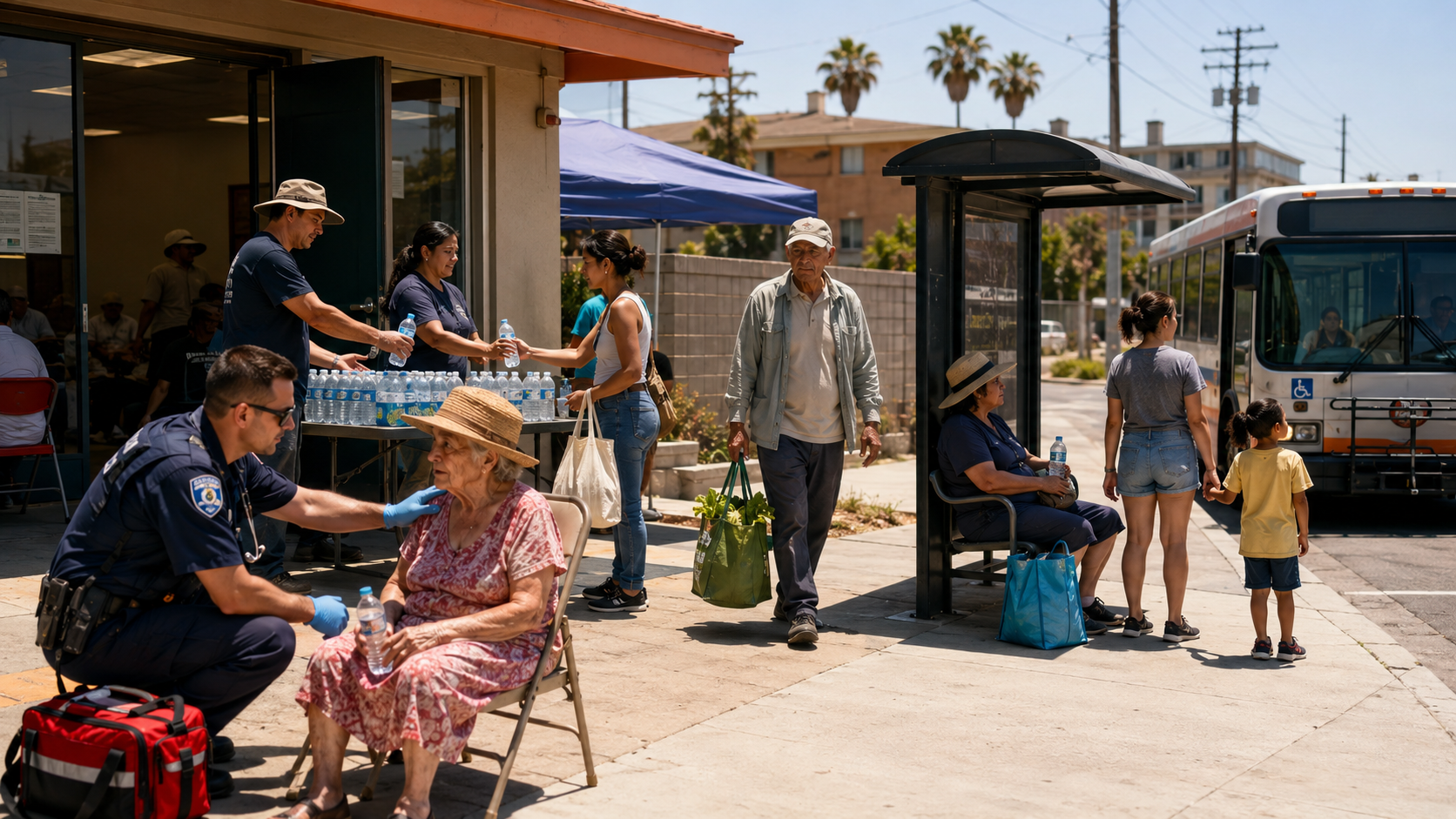
In Southern California, extreme heat is rarely an abstract future risk. It is something residents experience through the heat radiating from pavement, the strain of an air conditioner running for hours, the difficulty of waiting for a bus without shade, and the concern that an older relative or neighbor may be alone in a home that is becoming dangerously warm.
Those concerns became especially tangible again in July 2026. The National Weather Service issued an Extreme Heat Warning for the Ontario area during the mid-July heat episode, while forecasts elsewhere in Southern California warned of temperatures reaching between 95 and 110 degrees away from the coast. In portions of inland Los Angeles County, highs between 99 and 108 degrees were described as common during the peak of the heat. These temperatures were not merely uncomfortable. They placed simultaneous pressure on households, health systems, electrical infrastructure, transportation networks, outdoor workers, social-service organizations, and the residents with the fewest options for avoiding exposure (National Weather Service [NWS], 2026).
Public discussions about extreme heat often begin with a familiar recommendation: open cooling centers. Cooling centers are important, and access to air-conditioned public space can save lives. But a building with air conditioning is not, by itself, a comprehensive heat-response system. A cooling center has little value to a resident who cannot reach it, does not know it is open, depends on electrical medical equipment that cannot easily be transported, cannot leave a family member or pet behind, must continue working outdoors, or needs assistance after the facility closes for the evening.
The more important question, therefore, is not simply whether a community has cooling centers.
It is whether the community has functioning lifelines.
FEMA’s Community Lifelines framework provides a useful way to rethink extreme heat because it shifts emergency management away from viewing disasters solely as individual hazards and toward understanding the essential services that people depend upon to survive and function. FEMA defines lifelines as the critical services and functions necessary to sustain human health and safety, economic security, and the continuous operation of government and business. The current framework encompasses eight interconnected lifelines: Safety and Security; Food, Hydration, and Shelter; Health and Medical; Energy; Communications; Transportation; Hazardous Materials; and Water Systems (Federal Emergency Management Agency [FEMA], 2025; U.S. Environmental Protection Agency [EPA], 2026).
Viewed through this framework, an extreme heat emergency is not simply a period when temperatures become dangerously high. It is a test of whether the systems that make everyday life possible remain accessible when people need them most.
Cooling Centers Are an Endpoint, Not a Heat Strategy
Cooling centers are among the most visible municipal responses to extreme heat, but their existence can create a misleading impression that a community has adequately addressed the hazard.
Research has long recognized that access is more complicated than placing a cooling center on a map. A statewide analysis of cooling-center accessibility in New York found substantial differences in the ability of residents to reach these facilities depending on geography and transportation options. The researchers specifically concluded that accessible transportation can improve cooling-center utilization, underscoring the fact that a cooling center and a transportation system are functionally connected during a heat emergency (Nayak et al., 2019).
The Centers for Disease Control and Prevention has similarly treated cooling centers as only one component of a broader heat-response strategy that can include heat alerts, surveillance, wellness checks, hydration resources, public communication, and longer-term changes to the built environment (Widerynski et al., 2017).
This distinction matters operationally.
A cooling center is a resource. A community heat strategy is a network.
The success of the resource depends on whether the surrounding network functions.
Can residents receive information about the facility?
Can they travel there safely?
Does the building have reliable electricity?
Can people with disabilities access it?
Are water and food available?
Can medically fragile residents receive appropriate support?
Are hours aligned with the period of greatest heat risk, including dangerously warm evenings?
Can outreach teams identify people who will never independently seek out a cooling center?
These are lifeline questions.
Heat as a Health and Medical Lifeline Emergency
The most direct consequences of extreme heat appear in the Health and Medical Lifeline. Heat exhaustion and heat stroke are only the most visible outcomes. High temperatures can also worsen cardiovascular and respiratory conditions, contribute to dehydration and kidney stress, complicate medication management, and increase demand for emergency medical services.
CDC surveillance from the 2023 warm season demonstrated significant increases in heat-related emergency department visits across multiple regions of the United States during prolonged episodes of extreme heat. The findings also illustrated an important emergency-management principle: health impacts can escalate quickly enough that near-real-time surveillance becomes necessary for determining when public-health interventions should be intensified (Vaidyanathan et al., 2024).
But the Health and Medical Lifeline does not operate independently.
A homebound resident may be medically vulnerable because of age or chronic illness, but the immediate crisis may begin when the home’s air conditioning fails. The problem then moves from Health and Medical to Energy. If the individual cannot drive, the Transportation Lifeline becomes involved. If the person does not receive an emergency alert or wellness check, Communications becomes part of the failure. If no appropriate cooling or temporary housing option is available, Food, Hydration, and Shelter becomes another concern.
One vulnerable resident can therefore experience the degradation of several community lifelines simultaneously.
That is precisely why heat response should not be organized solely as a public-health campaign. It must be treated as a coordinated emergency-management operation.
Energy Is a Life-Safety System During Extreme Heat
During extreme heat, electricity becomes more than a utility. For many residents, it becomes life-safety infrastructure.
Air conditioning, refrigeration, elevators, communications equipment, mobility devices, medical equipment, pharmacies, hospitals, grocery stores, transit systems, and emergency facilities all depend to varying degrees on reliable power. At the same time that extreme heat increases dependence on electricity, it can also increase demand on the electrical system.
The consequences of simultaneous heat and electrical failure can be severe. Research modeling compound heat-wave and blackout scenarios in major U.S. cities found that the combination of prolonged extreme heat and widespread power loss could substantially amplify mortality and morbidity. In a subsequent analysis, Stone and colleagues found that a multiday blackout occurring during a heat wave could more than double estimated heat-related mortality rates in the cities examined (Stone et al., 2023).
This has profound implications for local heat planning.
A community cannot base its entire heat-response strategy on sending people into air-conditioned buildings without also asking whether those buildings can remain operational during an outage. Cooling centers, senior centers, libraries, community centers, shelters, health facilities, and other resilience hubs should be evaluated for backup power, generator connections, fuel continuity, facility cooling capacity, and the ability to operate during prolonged grid disruption.
The same planning should extend beyond government buildings.
Which apartment complexes house large populations of older adults?
Which skilled-nursing or assisted-living facilities lack robust backup cooling?
Where are residents dependent on powered medical devices?
Which neighborhoods have high heat exposure combined with limited household resources for cooling?
Which community organizations could become trusted neighborhood-level cooling or resource sites if primary facilities become inaccessible?
The Energy Lifeline reveals one of the central weaknesses in a cooling-center-only approach: a heat response built entirely around electricity-dependent cooling is itself vulnerable to the conditions that extreme heat can create.
Transportation Determines Whether Help Is Truly Accessible
Emergency planners sometimes treat transportation as a supporting service. During a heat emergency, it can determine whether every other intervention succeeds.
A cooling center five miles away may be functionally nonexistent for an older adult who no longer drives. A bus stop located several blocks from a person’s home may become a dangerous destination when the walking route has little shade. A missed connection can transform a routine transit trip into prolonged outdoor exposure.
Research has demonstrated that the design of transportation infrastructure itself influences heat exposure. In a 2025 study of Houston bus stops, researchers found tree-shaded areas to be approximately 3.2 degrees Celsius cooler than unshaded areas. The study also found that poorly designed enclosed shelters could actually increase heat stress compared with surrounding unshaded conditions, demonstrating that infrastructure intended to protect residents can become maladaptive when heat performance is not considered (Lanza et al., 2025).
Transportation planning must therefore become part of heat emergency planning.
Communities should know not only where cooling locations are located, but how residents without private vehicles will reach them. That analysis should include walking exposure, bus frequency, accessible transportation, paratransit capacity, pickup locations, transportation for people experiencing homelessness, and options for residents who cannot independently navigate the trip.
A lifeline approach changes the operational question from:
Where is the nearest cooling center?
to:
Can the resident safely reach cooling from where they are?
Those are not the same question.
Food, Hydration, and Shelter Must Function Together
FEMA combines food, hydration, and shelter within a single lifeline because disasters rarely allow these needs to be separated neatly. Extreme heat illustrates that interdependence particularly well.
Hydration is essential during periods of dangerous heat, but access to water is not universal simply because a faucet exists somewhere in the community. Outdoor workers, people experiencing homelessness, transit-dependent residents, isolated older adults, and people living in poorly cooled housing may need targeted access to water and other supportive resources.
Food access can also deteriorate indirectly. Power interruptions jeopardize household refrigeration and can affect grocery stores, food-service operations, food pantries, and medically necessary food storage. CDC guidance regarding outages emphasizes how quickly refrigerated food can become unsafe without electricity, illustrating the close relationship between the Energy and Food lifelines during emergencies (Centers for Disease Control and Prevention [CDC], 2024).
Sheltering presents an equally important challenge. A cooling center that operates during daytime business hours may provide temporary relief but leave unresolved the problem of a dangerously hot residence overnight. For people whose homes cannot maintain survivable temperatures, the question eventually shifts from temporary cooling to emergency sheltering or relocation.
That transition should not be improvised after conditions deteriorate.
Heat plans should establish thresholds for when a cooling operation becomes a sheltering operation, particularly during multiday events with high overnight temperatures, utility failures, or widespread residential cooling disruptions.
This is another important lesson from the lifeline framework: the condition of one lifeline can change the mission of another.
An energy failure can create a sheltering need.
A transportation failure can create a medical emergency.
A communications failure can leave residents unaware that assistance exists.
A water-system disruption during extreme heat can create an immediate public-health crisis.
The hazard may be heat, but the emergency is produced by interdependence.
Vulnerability Is Often the Absence of Alternatives
Emergency-management language frequently identifies older adults, people with disabilities, low-income households, outdoor workers, people experiencing homelessness, and medically fragile individuals as “vulnerable populations.”
The description is useful for identifying heightened risk, but it can obscure an important reality: vulnerability is often not an inherent characteristic of the person. It is produced or intensified by the systems surrounding that person.
An older adult with reliable air conditioning, affordable electricity, nearby family, private transportation, and access to health care may be far less vulnerable than another older adult living alone in an upstairs apartment with failing cooling and no transportation.
A person who uses a wheelchair may be safe during a heat emergency when accessible transportation and a properly equipped cooling destination are available, yet face serious risk when those systems are absent.
A low-income resident may technically have air conditioning but avoid using it because of the cost of electricity.
A transit-dependent worker may understand every heat-safety recommendation and still have no realistic option but to stand outside waiting for a bus.
The difference is not awareness.
It is access to functioning lifelines.
This reframes how emergency managers should identify heat vulnerability. Instead of asking only, Who is vulnerable?, communities should also ask:
Where do residents have the fewest alternatives when a lifeline fails?
That question produces a different kind of heat map—one that overlays temperature with energy insecurity, transportation access, medical dependence, housing conditions, social isolation, food access, and the location of trusted community institutions.
From Cooling Centers to a Lifeline-Based Heat Strategy
A mature extreme-heat strategy should still include cooling centers. But cooling centers should sit inside a larger operational system designed to maintain or restore critical community functions.
First, communities should assess lifeline conditions before a heat emergency occurs. Emergency managers should know which neighborhoods face the greatest combination of heat exposure and limited access to cooling, transportation, health care, water, food, and social support. FEMA’s lifeline construct is specifically intended to help decision-makers identify service disruptions, understand interdependencies, prioritize stabilization efforts, and communicate incident conditions in a common operational language (FEMA, 2025).
Second, heat plans should identify measurable indicators for each lifeline. Emergency operations centers could monitor heat-related emergency calls, emergency department trends, electrical outages, cooling-center occupancy, transit disruptions, requests for accessible transportation, water-system conditions, sheltering demand, and calls for food or utility assistance. The goal should be to identify degradation before a lifeline reaches failure.
Third, transportation should be treated as an intervention rather than an afterthought. Cooling resources should be paired with a plan for getting people to them. That may include transit partnerships, paratransit expansion, transportation vouchers, neighborhood pickup points, or mobile cooling resources.
Fourth, communities should build redundancy into cooling infrastructure. Libraries and recreation centers are valuable, but resilience may also depend on schools, houses of worship, nonprofit facilities, health centers, senior housing communities, and other trusted neighborhood institutions. Whole-community partnerships can increase the number of places where residents can receive cooling, hydration, information, wellness checks, charging capability, and referrals.
Fifth, heat planning should include scenarios in which the primary adaptation strategy fails. Emergency exercises should ask what happens when extreme heat coincides with a neighborhood power outage, transit disruption, wildfire smoke event, water-system problem, or communications outage. FEMA’s lifeline methodology is particularly valuable in these situations because it encourages planners to identify root causes and cascading consequences rather than treating every reported problem as an isolated incident.
Finally, communities should measure success by more than the number of cooling centers opened.
More meaningful questions include:
How many high-risk residents were contacted?
How many residents lacked transportation to cooling?
How long did neighborhoods remain without electricity?
Were cooling resources available during the hours of greatest risk?
Were medically dependent residents identified before an emergency occurred?
Could residents obtain water, food, medications, and reliable information?
Did community organizations have a defined role in the response?
How quickly were degraded lifelines identified and stabilized?
These measures tell emergency managers far more about community resilience than a simple count of facilities.
Heat Waves Reveal the Systems We Already Have
Extreme heat is sometimes described as a slow-moving disaster because it rarely arrives with the dramatic imagery associated with hurricanes, earthquakes, fires, or floods. There may be no collapsed building, no visible debris field, and no clearly defined moment when normal conditions become an emergency.
But the absence of visible destruction should not be mistaken for the absence of system failure.
Heat reveals whether an older resident can afford to cool a home.
It reveals whether the electrical grid can withstand sustained demand.
It reveals whether a person without a car can reach safety.
It reveals whether emergency communications reach people in languages and formats they understand.
It reveals whether food, water, medical care, and temporary shelter remain accessible.
It reveals whether government agencies, nonprofits, health systems, utilities, transportation providers, faith communities, and neighborhood organizations already know how they will work together.
In that sense, extreme heat does more than create a crisis.
It exposes the condition of the community before the crisis.
Cooling centers will remain an important tool for protecting residents from dangerous temperatures. But they should be understood as one node within a much larger system of community protection.
The next generation of heat preparedness must therefore move beyond asking whether a city can open an air-conditioned building when temperatures rise. The more consequential question is whether the community’s lifelines are strong enough to help residents reach that building, keep it operating, meet essential needs while they are there, identify those who will never arrive on their own, and continue protecting people if one part of the system fails.
That is the difference between providing a place to cool down and building a community capable of surviving extreme heat.
And as recent temperatures have reminded communities across Southern California, that distinction is becoming increasingly important.
References
Centers for Disease Control and Prevention. (2024). What to do to protect yourself during a power outage.
Federal Emergency Management Agency. (2025). Community Lifelines Implementation Toolkit. U.S. Department of Homeland Security.
Lanza, K., Ernst, S., Watkins, K., & Chen, B. (2025). Heat stress mitigation by trees and shelters at bus stops. Transportation Research Part D: Transport and Environment, 140, 104653. doi:10.1016/j.trd.2025.104653.
National Weather Service. (2026). Extreme heat warnings and weather outlooks for Southern California, July 2026. National Oceanic and Atmospheric Administration.
Nayak, S. G., Shrestha, S., Sheridan, S. C., Hsu, W.-H., Muscatiello, N. A., Pantea, C. I., Ross, Z., Kinney, P. L., Zdeb, M., Hwang, S.-A. A., & Lin, S. (2019). Accessibility of cooling centers to heat-vulnerable populations in New York State. Journal of Transport & Health, 14, 100563. doi:10.1016/j.jth.2019.05.002.
Stone, B., Jr., Gronlund, C. J., Mallen, E., Hondula, D. M., O’Neill, M. S., Rajput, M., Grijalva, S., Lanza, K., Larsen, L., Augenbroe, G., Krayenhoff, E. S., Broadbent, A., & Georgescu, M. (2023). How blackouts during heat waves amplify mortality and morbidity risk. Environmental Science & Technology, 57(22), 8245–8255. doi:10.1021/acs.est.2c09588.
U.S. Environmental Protection Agency. (2026). FEMA’s Community Lifelines Construct.
Vaidyanathan, A., Gates, A., Brown, C., Prezzato, E., & Bernstein, A. (2024). Heat-related emergency department visits—United States, May–September 2023. Morbidity and Mortality Weekly Report, 73(15), 324–329. doi:10.15585/mmwr.mm7315a1.
Widerynski, S., Schramm, P. J., Conlon, K. C., Noe, R. S., Grossman, E., Hawkins, M., Nayak, S. G., Roach, M., & Shipp Hilts, A. (2017). The use of cooling centers to prevent heat-related illness: Summary of evidence and strategies for implementation. Centers for Disease Control and Prevention.

Leave a Reply
You must belogged in to post a comment.